How Items Work in League of Legends: Starters, Boots and Legendary Items
A plain-English guide to League of Legends items as of 2026: starters, basic and epic components, boots tiers, legendary items, consumables and build paths.

Champions in League of Legends get stronger in two ways during a match: they level up, and they buy items. Levels arrive more or less automatically as you gain experience, but items are a series of choices. What you buy, in what order and when you go back to base to buy it has a large effect on whether your champion feels powerful or useless by the twenty-minute mark.
This guide explains how the item system is organized, from the starter items you pick in the first second of the game to the legendary items that define a finished build. It also covers boots, consumables, gold efficiency and how itemization has changed over recent seasons, including the removal of Mythic items in 2024 and the Role Quest system added in 2026. Item names and stats are adjusted almost every patch, so the focus here is on the structure, which stays stable, rather than on any specific “best build.” Details reflect the official League of Legends wiki as of October 2026.
The Inventory: Six Slots and a Trinket
Every champion has six main inventory slots plus a separate trinket slot for a vision trinket such as the Stealth Ward. That limit is the foundation of itemization. A finished champion usually carries boots and five other items, so every slot spent on something temporary, like a starter item, is eventually sold or replaced to make room for something stronger.
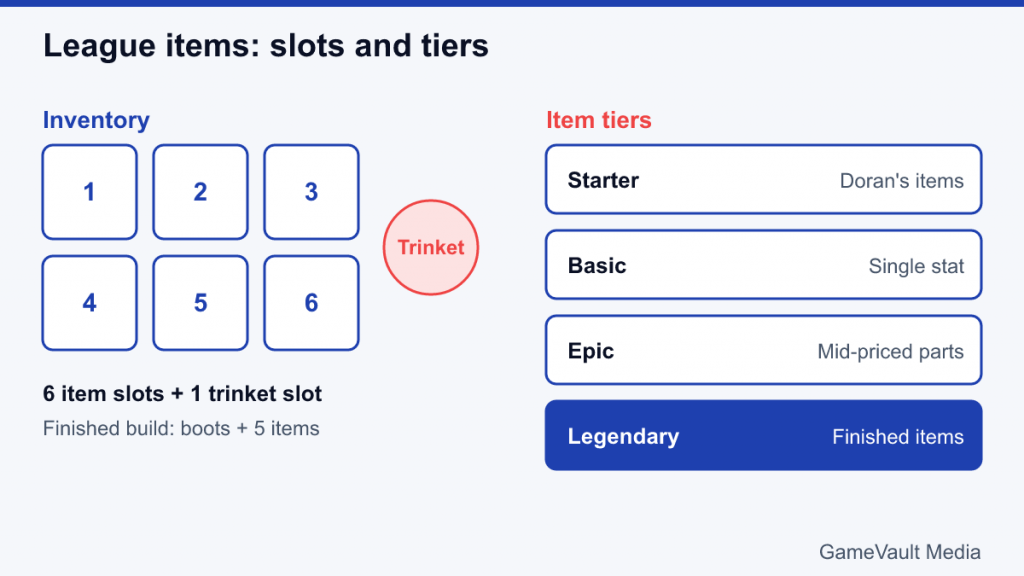
Since the 2026 season there is also a Role Quest slot on Summoner’s Rift in queues with assigned positions. It holds role-specific rewards and, for some roles, specific items such as boots or Control Wards. It is covered in more detail below.
The Item Tiers
The official wiki groups League’s purchasable items into a handful of categories. Understanding the categories makes the shop far less intimidating, because almost every item fits a predictable pattern.
| Category | What it does | Typical examples |
|---|---|---|
| Starter | Modest early power for the laning phase; usually not part of a recipe | Doran’s Blade, Doran’s Ring, Doran’s Shield, jungle pets, support quest item |
| Basic | Cheap items that grant a single stat | Long Sword, Amplifying Tome, Cloth Armor, Ruby Crystal |
| Epic | Mid-priced components with higher stats and sometimes a small effect | Pickaxe, Kindlegem, Caulfield’s Warhammer |
| Legendary | Finished items built from basic and epic components; the strongest stats and effects | Infinity Edge, Rabadon’s Deathcap, Sunfire Aegis |
| Boots | A separate line that grants movement speed; only one pair can be equipped | Boots, Plated Steelcaps, Sorcerer’s Shoes |
| Consumables | Single-use or limited-use effects | Health Potion, Control Ward, Elixirs |
Starter items
At the start of the game you have enough gold for one starter item and usually a potion. Starters are designed for the laning phase. The Doran’s items, for example, give a small bundle of stats suited to attack damage, ability power or durability. Junglers start with a jungle pet companion, and supports start with the support quest item. Because starters do not build into anything, they are eventually sold when inventory space becomes tight.
Basic and epic components
Basic items give a single stat, such as attack damage, ability power, health or armor. Epic items cost more, give more stats and sometimes carry a small passive. Most epic items are themselves built from basic components, and legendary items are built from a mix of both. This layered recipe system means you rarely need to save up the full price of a legendary item at once. You can buy the pieces as you go and the cost already paid is deducted when you complete the recipe.
Legendary items
Legendary items are where a champion’s power really comes from. They combine large stat bonuses with passive or active effects: a critical strike multiplier, a burst of magic penetration, a shield, a slow, a stasis effect and so on. By default, you can only equip one copy of each legendary item, and some items belong to groups that cannot be combined, so you cannot stack the same effect twice by buying two items that share it.
Boots: A Separate Line
Boots work differently from other items. You can only carry one pair, and they grant flat movement speed rather than a percentage. As of 2026 there are three tiers:
- Tier 1 Boots grant a small amount of movement speed and are the base for every upgrade.
- Tier 2 boots are purchased upgrades with more movement speed and a role-specific bonus, such as armor and reduced damage from basic attacks on Plated Steelcaps or magic penetration on Sorcerer’s Shoes.
- Tier 3 boots are exclusive upgrades of tier 2 boots. Since the 2026 season, mid laners who complete their Role Quest have their tier 2 boots upgraded to the tier 3 version automatically.
Choosing boots is often a reaction to the enemy team. Armor-focused boots help against teams with many auto-attackers, while boots with tenacity help against heavy crowd control. Some champions skip boots for a long time because they have their own mobility, but most players buy them early in the game, since movement speed affects everything from dodging skill shots to arriving at fights first.
Consumables, Trinkets and Distributed Items
Consumables include Health Potions, Control Wards and the Elixirs that late-game champions buy for a temporary stat boost. They do not build into anything, but they solve practical problems: staying in lane longer, denying enemy vision or squeezing a little extra power into a decisive fight.
The trinket slot holds a vision tool, typically the Stealth Ward or the Oracle Lens. Swapping trinkets is free, and it is one of the most important decisions you make for your team’s vision. Finally, the wiki lists distributed items, which you do not buy at all. They appear in your inventory when you fulfill some condition, and they go into the next open slot.
Role Quests: Items Tied to Your Position (2026)
The biggest itemization change of the 2026 season was the introduction of Role Quests in patch 26.1. In Summoner’s Rift queues with assigned positions, each player receives a quest based on their role. Points come from playing that role: farming in lane, taking turrets and plates, securing epic monsters and, for supports, using the support item’s charges. When the quest is complete, you receive a role-specific reward.
- Top lane: an extra “Unleashed” Teleport and bonus experience, with a higher level cap.
- Jungle: an upgraded Smite and extra gold, experience and movement speed in the jungle.
- Mid lane: bonus attack damage and ability power, plus a free upgrade of tier 2 boots to tier 3.
- Bot lane: extra gold and a dedicated slot for boots, which effectively gives the marksman a seventh item slot.
- Support: the support item upgrades into its final forms, and Control Wards are stored in the quest slot at a lower price.
Role Quests reward staying in your lane early. Points earned away from your lane are reduced, though the system allows some roaming time. If you are not sure what each role is meant to do in the first place, our guide to League of Legends roles covers the basics.
Gold Efficiency and Build Paths
Players often talk about gold efficiency. The idea is simple: each stat in League has an implied gold value, usually calculated from the cost of the basic item that grants only that stat. If a Long Sword costs a certain amount and gives a certain amount of attack damage, you can work out what one point of attack damage is “worth.” Comparing an item’s total stats to its price tells you whether it is gold efficient. Legendary items are frequently more than 100% gold efficient once their passive effects are counted, which is part of why completing them feels like a large power jump.
Gold efficiency is a useful lens, but it is not the whole picture. An item that gives you exactly what your champion needs, such as a stasis effect against an assassin, can win a game even if it is not the most efficient stat package.
Build paths
A build path is the order in which you buy components on the way to a finished item. Good build paths give you the most useful stats first. For example, a marksman might buy a damage component before a defensive one so that they can keep up in lane, while a tank facing a burst mage might buy a magic resistance component early. Because components are cheaper than finished items, a smart build path lets you turn small amounts of gold into immediate strength each time you recall.
Power spikes
A power spike is the moment a champion becomes noticeably stronger, often when a key legendary item is completed. Many champions have a recognizable first-item spike, and experienced players watch the enemy’s gold and inventories to avoid fighting right after an opponent completes theirs. Our guide to champion classes explains why different classes want very different stats.
How Itemization Has Changed: The Mythic Era and After
League’s item system has been overhauled several times. The biggest recent changes came in two steps.
Mythic items (2021–2023). In the preseason before the 2021 season, Riot introduced a new top tier called Mythic items. Each champion could own only one Mythic, which gave a strong unique effect plus bonus stats for every other legendary item in the inventory. The idea was to give each build a clear identity, but in practice many champions felt locked into the same Mythic choice every game.
Mythics removed (2024). Patch 14.1, which opened the 2024 season in January 2024, removed the Mythic tier entirely. Former Mythics were reworked into legendary items or removed, many new items were added, and the old support item lines were replaced by a single starter that upgrades into several final forms. Itemization returned to a more open model where any combination of legendary items is allowed, subject to the uniqueness rules.
Role Quests (2026). As described above, patch 26.1 tied some item rewards to role performance, including tier 3 boot upgrades for mid laners and a dedicated boots slot for bot laners.
Practical Tips for New Players
- Use the recommended items tab. The in-game shop suggests builds for your champion. It is a reasonable starting point while you learn.
- Do not hoard gold. Gold does nothing until you spend it. Recall when you can afford a meaningful component.
- Buy boots early. Unless your champion has a specific reason to delay them, early movement speed helps in every situation.
- React to the enemy team. Look at the enemy’s damage types. If most of their damage is physical, armor is more valuable than magic resistance, and vice versa.
- Remember the undo button. The shop lets you undo recent purchases while you are still in base, which is useful when you misclick.
- Sell starters late. Starter items are cheap, and you usually only need to sell them when your inventory is full.
For a broader set of fundamentals beyond items, such as farming, recalling and map awareness, see our League of Legends beginner’s guide.
Frequently Asked Questions
Are Mythic items still in League of Legends?
No. The Mythic tier was removed in patch 14.1 in January 2024. Finished items are now all legendary items.
How many items can you carry?
Six main items plus a trinket. In 2026, the Role Quest slot can also hold boots for bot laners and Control Wards for supports.