League of Legends Champion Classes Explained: Tanks, Mages, Marksmen and More
Riot's seven champion classes and their subclasses explained, with example champions, typical roles and how classes fit into a team composition.
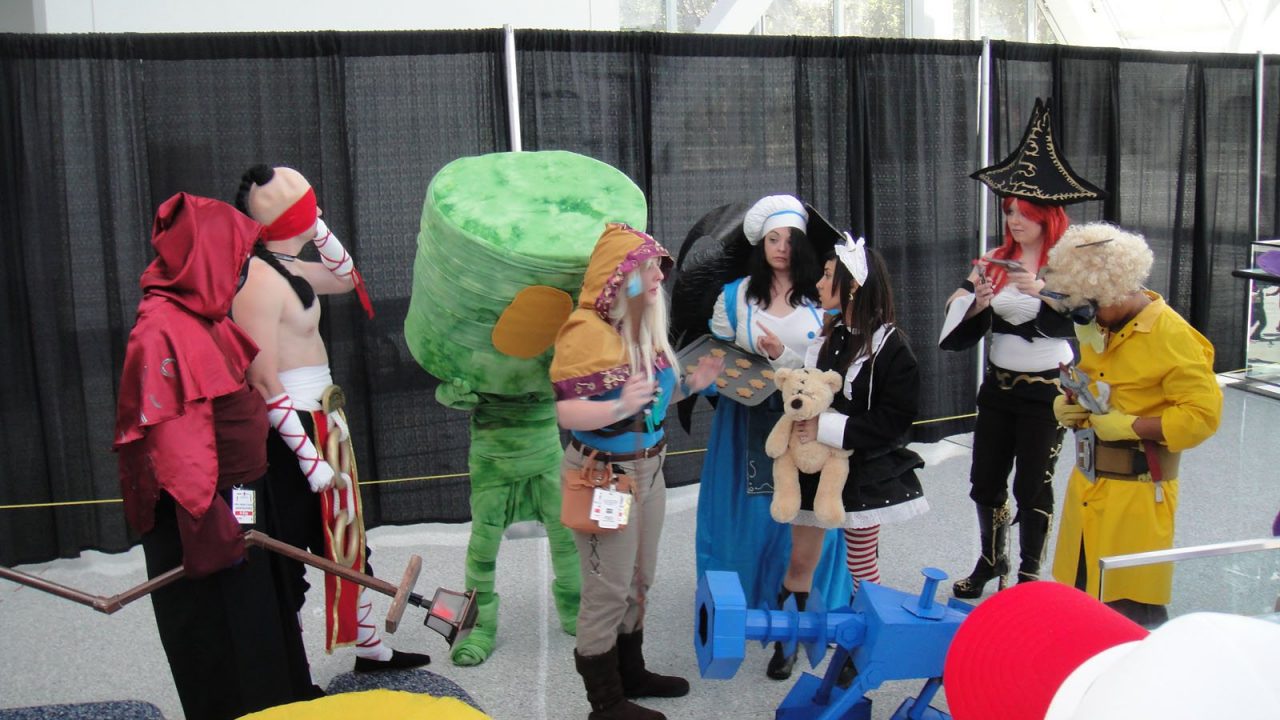
League of Legends has a very large roster, and new players often find it hard to know what a champion does just by looking at them. Riot’s answer is a class system: a set of labels that describe how a champion is meant to fight. Knowing a champion’s class tells you whether they want to be in the front or the back of a fight, whether they deal damage in bursts or over time, and roughly what kind of items they buy.
This guide covers the seven main classes and their subclasses as listed on the official League of Legends wiki, gives examples for each, and explains how classes connect to positions and team compositions. If you are not yet familiar with League’s five positions, our roles guide is a helpful companion.
Classes Are Not Roles
The first thing to understand is that a class and a role are different. A role (or position) is where you play on the map: top, jungle, mid, bottom or support. A class describes how a champion fights. Many classes appear in several roles. A tank might play top lane, jungle or support. A mage might play mid, support or occasionally bottom.
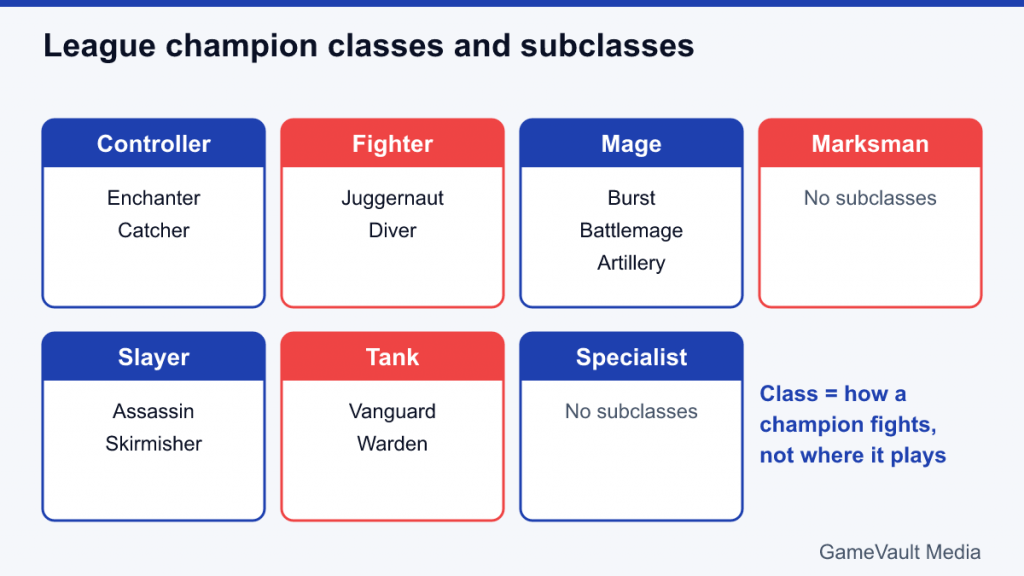
Riot reworked and formalized its class framework in 2016 and 2017, organizing champions into classes and subclasses that it used to guide champion updates. Some champions fit cleanly into one subclass, while others sit between two. The categories below are a guide, not a rulebook.
Controller: Enchanters and Catchers
Controllers are defensive casters who protect allies or create opportunities for them. They are usually fragile and do not deal much damage themselves, so they rely on teammates to finish what they start.
Enchanters
Enchanters heal, shield and buff their allies. They make a well-fed teammate even more dangerous and help their team survive long fights. Examples: Janna, Sona, Soraka, and champions such as Lulu and Nami that are also commonly placed in this group.
Catchers
Catchers lock down enemies with crowd control, often by controlling space with zones of threat or long-range abilities. A single hit from a catcher can decide a fight by pulling or immobilizing a key target. Examples: Blitzcrank, Morgana, Zyra.
Where they play: almost always support. Controllers need little gold to function and make the most of the support’s role as protector and playmaker.
Fighter: Juggernauts and Divers
Fighters are durable melee champions who deal steady damage while standing in the middle of combat. They sit between tanks and damage dealers.
Juggernauts
Juggernauts can deal and absorb huge amounts of damage, but they have short range and limited mobility. They are strong when enemies come to them and weak when kited. Examples: Darius, Dr. Mundo, Mordekaiser, with Garen and Sett often grouped alongside them.
Divers
Divers trade some durability for mobility. They jump onto a priority target, often the enemy’s back line, and stick to it. Examples: Hecarim, Jarvan IV, Vi.
Where they play: fighters are the backbone of top lane and are common in the jungle. Their mix of damage and durability suits long side-lane duels and skirmishes over objectives.
Mage: Burst, Battlemage and Artillery
Mages are ranged casters who deal damage with abilities rather than basic attacks. The class has the most variety, which is why Riot split it into three subclasses.
Burst mages
Burst mages lock down a target and delete them with a quick combination of abilities. They are deadly when they land their full combo and much weaker when it is on cooldown. Examples: Annie, Syndra, Veigar.
Battlemages
Battlemages stay in the thick of fights, dealing sustained area damage and relying on defensive tools to survive. Examples: Rumble, Swain, Vladimir.
Artillery mages
Artillery mages damage enemies from extreme range, wearing them down before a fight begins. They are fragile and have little mobility, so they need protection. Examples: Jayce, Xerath, Ziggs.
Where they play: burst mages and artillery mages are classic mid laners. Some battlemages play top lane or jungle, and several mages also appear as damage-focused supports.
Marksman
Marksmen deal reliable, sustained damage at range, mostly through basic attacks. They are fragile, depend heavily on items and grow into one of the strongest threats in the late game. They are also the main source of damage against durable targets such as tanks and objectives. Unlike most classes, marksmen have no official subclasses. Examples: Ashe, Ezreal, Lucian, Kai’Sa, Jhin.
Where they play: bottom lane, almost always alongside a support. Some marksmen with strong early damage or long range, such as Caitlyn or Ezreal, occasionally appear in other lanes.
Slayer: Assassins and Skirmishers
Slayers are agile melee damage dealers who are fragile compared with fighters but excel at taking down specific targets quickly.
Assassins
Assassins use mobility and stealth to reach high-priority targets, kill them in a few seconds and escape. They thrive on picking off isolated enemies. Examples: Akali, Evelynn, Zed, along with champions like Talon and Kha’Zix.
Skirmishers
Skirmishers deal extreme sustained damage to nearby enemies and have situational defensive tools to survive short, intense fights. They are often called duelists. Examples: Fiora, Jax, Yasuo.
Where they play: assassins usually play mid lane or jungle, where they can roam and find picks. Skirmishers are common in top lane, where long one-on-one fights suit their kits.
Tank: Vanguards and Wardens
Tanks absorb damage and disrupt enemies rather than dealing heavy damage themselves. A good tank makes the enemy waste abilities on the wrong target.
Vanguards
Vanguards are offensive tanks who start fights and catch enemies out of position. Their job is to pick the moment the fight begins. Examples: Amumu, Leona, Sejuani, with Malphite often named alongside them.
Wardens
Wardens are defensive tanks who hold the line, protect allies and punish anyone who tries to reach their back line. Examples: Braum, Shen, Tahm Kench.
Where they play: top lane, jungle and support. Vanguards suit engage-heavy compositions, while wardens are prized in teams built around a strong marksman who needs protection.
Specialist: Champions That Do Their Own Thing
Some champions do not fit any class. Riot groups them as specialists. Each has a unique play pattern: summoning soldiers, setting traps, leaving poison trails or building turrets. Examples: Azir, Teemo, Heimerdinger, Singed, Gangplank. Specialists have no subclasses because their defining trait is that they are unusual. They are often harder to learn but can be rewarding once mastered.
How Classes Fit Into Team Compositions
A strong team usually includes several classes so it can handle different situations. A common recipe looks like this:
| Need | Classes that provide it |
|---|---|
| Frontline that can absorb damage | Tanks, juggernauts |
| Engage (starting fights) | Vanguards, divers, catchers |
| Sustained physical damage | Marksmen, skirmishers |
| Magic damage | Mages, some assassins and tanks |
| Protection for carries | Enchanters, wardens |
| Picking off isolated targets | Assassins, catchers |
Mixing damage types matters because of items. If all five champions deal physical damage, the enemy can buy armor and largely neutralize them. Balancing physical and magic damage forces the enemy to split their defenses.
Teams also tend to build around a theme. Some common archetypes are:
- Dive: divers and vanguards jump onto the enemy back line together.
- Protect the carry: enchanters and wardens keep a marksman alive while it deals damage.
- Poke: artillery mages and long-range champions wear enemies down before objectives.
- Pick: catchers and assassins hunt isolated targets in the fog.
- Split push: a skirmisher or juggernaut pressures a side lane while the rest of the team holds the middle.
Understanding these archetypes helps in champion select. If your team already has two assassins and no frontline, picking a tank or juggernaut will usually help more than a third damage dealer.
Using Classes to Read the Enemy Team
Classes are also a quick way to understand your opponents. When you see a burst mage on the enemy team, you know to avoid being caught alone without protection. Facing several divers, you know your back line needs help or defensive items. Against a team of artillery mages, you want to engage quickly instead of letting them chip you down. Against a split-pushing skirmisher, you plan who will answer the side lane.
For new players, this is one of the most useful things the class system offers. You do not need to memorize every enemy ability to make reasonable decisions. Knowing what class a champion belongs to tells you most of what you need.
Choosing a Class to Start With
If you are new and unsure what suits you, the class system offers a shortcut:
- Like being in the middle of fights and hard to kill? Try a juggernaut or vanguard.
- Prefer staying at range and dealing damage? Try a marksman or burst mage.
- Enjoy helping teammates and watching the whole fight? Try an enchanter.
- Want flashy plays and solo kills? Try a skirmisher or, once comfortable, an assassin.
Simple champions within each class, such as Garen, Annie, Ashe, Soraka and Malphite, make good starting points because their abilities are easy to understand. Once you are comfortable with one class, branching out to its neighbor (for example, from enchanter to catcher, or from juggernaut to diver) is a natural next step. For more on how champions use the map, see our Summoner’s Rift map guide.
Quick Questions About Classes
Can a champion belong to two classes? Yes. Many champions sit between subclasses, such as a fighter with some tank traits or a mage with assassin-like burst. The wiki lists a primary class and sometimes a secondary one.
Do classes change? Occasionally. When Riot reworks a champion’s abilities, the champion may move to a different subclass. The broad class framework itself has stayed stable for years.
Is this the same as the tags in the client? Not exactly. The client’s champion filters use a simpler, older set of tags such as Assassin, Fighter, Mage, Marksman, Support and Tank. They overlap with the class system but are broader, so the wiki’s subclasses give a more precise picture of how a champion plays.