Dota 2 Hero Attributes Explained: Strength, Agility, Intelligence and Universal
What Strength, Agility and Intelligence give a Dota 2 hero, how primary attributes and Universal heroes work, and how stats shape roles and items.

Every Dota 2 hero has three attributes: Strength, Agility and Intelligence. They sit on the left side of the hero’s portrait as three numbers that grow each level, and they quietly drive a large part of how a hero plays. Attributes decide how much health and mana a hero has, how hard it hits, how fast it attacks and how much armor it starts with. One of them, or in the case of Universal heroes all three together, also determines the hero’s attack damage.
This guide explains what each attribute does, how primary attributes work, what changed when Universal heroes were introduced, and how attributes connect to roles and items. Per-point values below are current as of patch 7.41 in 2026; Valve does tweak them occasionally, so the in-game tooltip on each attribute is the final word.
The Three Attributes at a Glance
Each point of an attribute gives a fixed set of bonuses to any hero, regardless of the hero’s primary attribute.
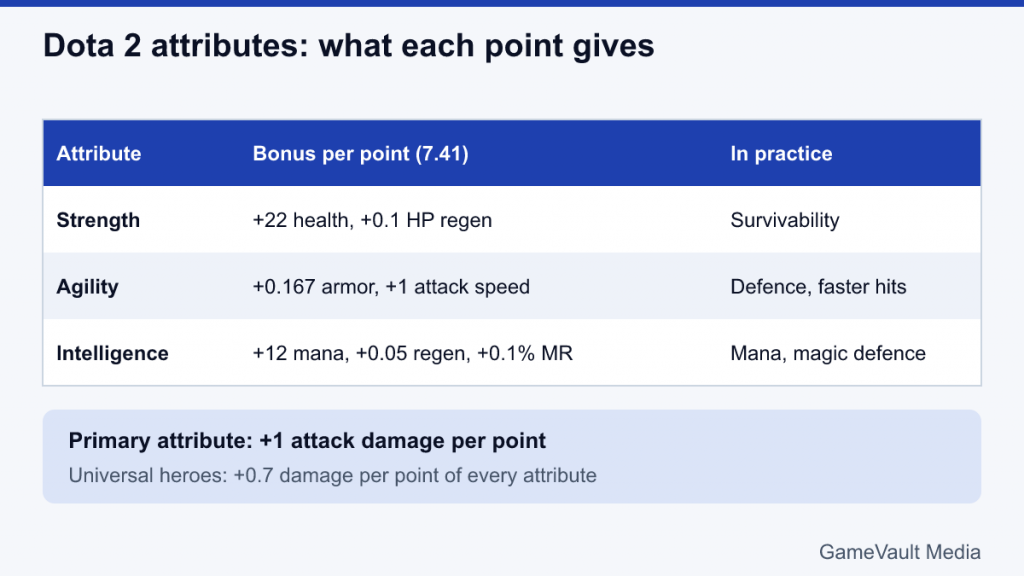
| Attribute | Bonus per point (patch 7.41) | What it means in practice |
|---|---|---|
| Strength | +22 maximum health, +0.1 health regeneration | Survivability: more health and faster recovery |
| Agility | +0.167 armor, +1 attack speed | Physical defense and faster attacks |
| Intelligence | +12 maximum mana, +0.05 mana regeneration, +0.1% magic resistance | Bigger mana pool, faster mana recovery and some magic defense |
Some older bonuses have been removed over the years and still show up in outdated guides. Agility once gave a small amount of movement speed and Intelligence once gave spell amplification; neither does today. If a guide lists those bonuses, it predates the current rules.
These numbers look small one point at a time, but they add up. A hero with 40 Strength has 880 more health from Strength alone than a hero with zero, and a hero with 60 Agility has roughly 10 extra armor and 60 extra attack speed.
Primary Attributes and Attack Damage
Every hero has a primary attribute, shown by an icon next to the hero’s name. It has one extra effect beyond the bonuses above: it adds to the hero’s attack damage.
- Strength heroes gain +1 attack damage per point of Strength.
- Agility heroes gain +1 attack damage per point of Agility.
- Intelligence heroes gain +1 attack damage per point of Intelligence.
- Universal heroes gain +0.7 attack damage per point of every attribute.
This is why items that add a hero’s primary attribute are especially efficient: they increase damage on top of their normal bonuses. A pair of Slippers of Agility is worth more to an Agility hero than to a Strength hero, because only the Agility hero gets the extra damage.
Heroes also differ in their attribute gain per level. Each hero has its own base values and growth rates for each attribute, so two Strength heroes can scale very differently. The primary attribute is usually, though not always, the one with the highest growth.
Strength Heroes
Strength heroes tend to be durable. Their high health pools and regeneration let them stay in lane longer, absorb damage in fights and survive initiations. Many offlaners, tanky supports and initiators are Strength heroes, as are some carries that rely on staying alive in the middle of fights.
Typical traits of Strength heroes:
- Large health pools that make them hard to burst down.
- Often melee, with abilities designed for initiating or holding the front line.
- Comparatively low mana and armor unless itemized for it.
Classic examples include Axe, Tidehunter and Pudge, heroes built around initiating fights or absorbing punishment.
Agility Heroes
Agility heroes typically fill the hard carry role. Agility’s attack speed and armor bonuses scale well with items that add even more Agility, and many Agility heroes have abilities that amplify their right-click damage. They are often weak in the early game and become dominant once they have farmed key items.
Typical traits of Agility heroes:
- Fast attacks and good armor, especially later in the game.
- Lower health, so they are vulnerable to burst damage and disables before they have defensive items.
- High farm priority, often playing position 1.
Anti-Mage, Phantom Assassin and Drow Ranger are well-known examples. Our guide to Dota 2 positions 1–5 explains why these heroes usually receive the most farm on the team.
Intelligence Heroes
Intelligence heroes are usually spellcasters. Their large mana pools let them use abilities frequently, and many of them have powerful disables or nukes. They are common as supports and mid laners, and some scale into strong late-game casters.
Typical traits of Intelligence heroes:
- Big mana pools and good mana regeneration.
- Often ranged, with lower health than Strength heroes.
- Abilities that matter more than right-click damage.
Crystal Maiden and Lion are familiar Intelligence supports, both relying on spells rather than attacks. The extra magic resistance from Intelligence also gives these heroes a little protection against enemy spellcasters.
Universal Heroes
Universal was introduced as a fourth primary attribute in patch 7.33, the “New Frontiers” update released in April 2023. Valve moved 31 existing heroes into the new category, generally heroes whose kits did not fit neatly into Strength, Agility or Intelligence, or whose stat spread was already fairly balanced. The initial damage value per point was lower and was raised to 0.7 in a follow-up hotfix, the figure still used in 2026.
The defining rule is how they gain damage. Instead of +1 damage per point of a single attribute, Universal heroes gain 0.7 damage per point of every attribute. A Universal hero with high totals in all three can deal strong damage, while one that is lopsided gains less from its weaker stats.
Practical consequences of Universal heroes:
- Items that add all attributes, such as those built from Ultimate Orb, are especially attractive because they boost damage three times over.
- Single-attribute items are less efficient for damage than they would be for a hero with that primary attribute.
- Role variety. Universal heroes appear in every position, from cores to supports, which makes the category a description of stat scaling rather than of role.
Pangolier, Void Spirit and Windranger are examples of heroes in the Universal category as of 2026.
How Attributes Shape Items and Builds
Attributes are one of the main reasons item choices differ between heroes. A few patterns:
- Power Treads let you choose which attribute receives the boots’ bonus, and switching between them to save mana or gain health is a classic technique.
- Primary attribute items such as Eaglesong, Reaver and Mystic Staff, or their smaller components, give both stats and extra damage to heroes of the matching attribute.
- All-stat items help every hero but are most efficient on Universal heroes.
- Counter-building. An Intelligence hero who keeps dying to physical burst may need armor or health that their attributes do not naturally provide.
Our explainer on Dota 2 items covers components, recipes and item categories in more detail.
Attributes and Leveling
Besides growing naturally each level, attributes can be boosted through items, through some abilities, and through options in a hero’s talent tree, which often includes a choice that adds all attributes or a large amount of one attribute.
Because heroes reach high levels in long games, attribute scaling is one reason why some heroes are described as “late-game” heroes. A hero with high Agility gain per level, for example, keeps adding armor and attack speed even before buying more items.
A Worked Example: Same Item, Different Heroes
Consider a Band of Elvenskin, a cheap component that adds Agility. Using the per-point values above, here is roughly what each point of that Agility is worth to different heroes:
| Hero’s primary attribute | Armor | Attack speed | Attack damage |
|---|---|---|---|
| Agility | +0.167 | +1 | +1 |
| Universal | +0.167 | +1 | +0.7 |
| Strength or Intelligence | +0.167 | +1 | None |
The armor and attack speed are identical for everyone; only the damage changes. That is the whole logic of primary attributes in one table, and it explains why an Agility carry happily stacks Agility items while a Strength offlaner usually looks elsewhere for damage.
Common Misunderstandings
- “Strength heroes can’t carry.” Several Strength heroes are effective carries. Primary attribute describes stat scaling, not role.
- “Agility makes you faster.” Agility no longer gives movement speed; it gives attack speed and armor.
- “Intelligence boosts spell damage.” Spell amplification from Intelligence was removed. It now provides mana, mana regeneration and magic resistance.
- “Only the primary attribute matters.” Every hero receives the health, armor, attack speed, mana and magic resistance from all three attributes. A carry with very low Strength is fragile no matter how much Agility it has, which is why many carries buy some Strength or health items even though those stats add no damage.
- “Universal heroes get bonuses from everything, so they are always stronger.” They gain less damage per point than a single-attribute hero does from its primary, so they need balanced stats to benefit fully.
Reading the Numbers in Game
The Dota 2 client makes attribute information easy to check. Hovering over a hero’s attribute values shows the exact contribution of each attribute, and the hero page in the client and on the official site lists base values and gain per level. When you are learning a new hero, a quick look at its attribute growth tells you a lot: high Strength gain suggests a durable hero, high Agility gain often means a hero that scales into the late game, and high Intelligence gain supports frequent spell use.
Understanding attributes is not about memorizing numbers. It is about recognizing why a hero feels the way it does, and why certain items make that hero so much stronger.