Dota 2 Positions 1–5 Explained: Carry, Mid, Offlane and Supports
How Dota 2's position 1–5 system works, what the carry, mid, offlaner and two supports do, and why Dota roles are more fluid than League's.
Ask a Dota 2 player what they play and you will often hear a number rather than a name: “I’m a pos 3 player” or “I’ll go 5 this game.” Dota sorts its five players by farm priority, a ranking of who should get the most gold and experience. Position 1 gets the most, position 5 gets the least. The numbers are a community convention that Valve’s matchmaking now reflects, and they are the quickest way to understand what each player on a Dota team is supposed to be doing.
This guide explains each position, the lanes they usually play, how supports earn their keep and why Dota roles bend more than the fixed positions you may know from League of Legends. If you are new to the genre itself, our introduction to MOBAs covers the basics first.
Farm Priority: The Idea Behind the Numbers
Gold and experience in Dota come mostly from killing lane creeps and neutral creeps in the jungle. Those resources are limited, so a team has to decide who gets them. Heroes differ greatly in how much they benefit from items. Some, like Anti-Mage or Spectre, are weak early but become overwhelming with expensive items. Others, like Lion or Crystal Maiden, are useful from the first minute even with almost no gold.
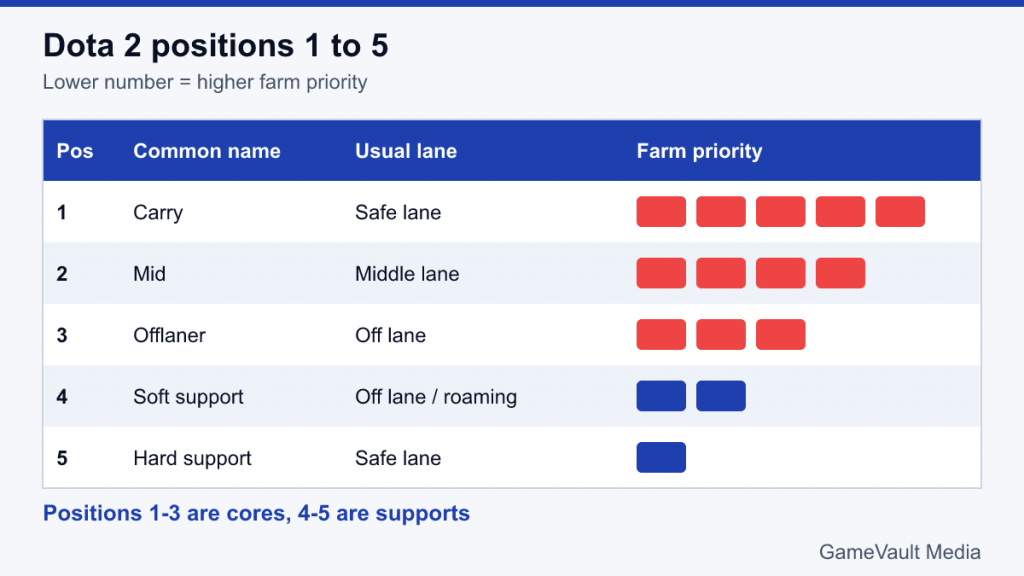
The position system turns that difference into a plan:
| Position | Common name | Usual lane | Farm priority |
|---|---|---|---|
| 1 | Carry (hard carry) | Safe lane | Highest |
| 2 | Mid | Middle lane | Second |
| 3 | Offlaner | Off lane | Third |
| 4 | Soft support (roaming support) | Off lane or roaming | Fourth |
| 5 | Hard support | Safe lane | Lowest |
Positions 1 to 3 are called cores. Positions 4 and 5 are supports. When Valve reworked ranked matchmaking in 2020, it dropped separate core and support ratings and moved to a single rating with role-based adjustments, listing the five roles as safe lane, mid lane, off lane, soft support and hard support. Players choose one or more of these before queuing, which is why the numbering has become universal vocabulary.
Safe Lane and Off Lane: Why the Lanes Are Not Equal
Dota’s map has three lanes, but the two side lanes are not mirror images in practice. Each team has a safe lane, where its tier-one tower sits farther forward so creep waves tend to meet closer to the team’s own side. For the Radiant (bottom-left base) the safe lane is the bottom lane, and for the Dire (top-right base) it is the top lane. The opposite side lane is each team’s off lane, sometimes called the hard lane.
In the safe lane, the carry can farm with a friendly tower nearby and a support at their side. The off lane is the reverse: the offlaner fights far from their tower against the enemy carry and support. That is why the safe lane goes to the player who most needs gold and the off lane goes to a durable hero who can survive pressure.
Position 1: The Carry
The carry is the hero meant to win the late game. Early on, carries are usually fragile and rely on their support to keep them safe while they last hit creeps. Their entire early game revolves around farming efficiently: landing last hits, denying enemy creeps and staying alive.

- Early game: farm the safe lane, avoid unnecessary fights, aim for a key first item.
- Mid game: keep farming the jungle and side lanes, join fights only when they matter or when the team needs help, and avoid dying, since each death costs gold and farm time.
- Late game: become the team’s main damage dealer and win decisive fights. The carry often decides whether to use buyback after dying.
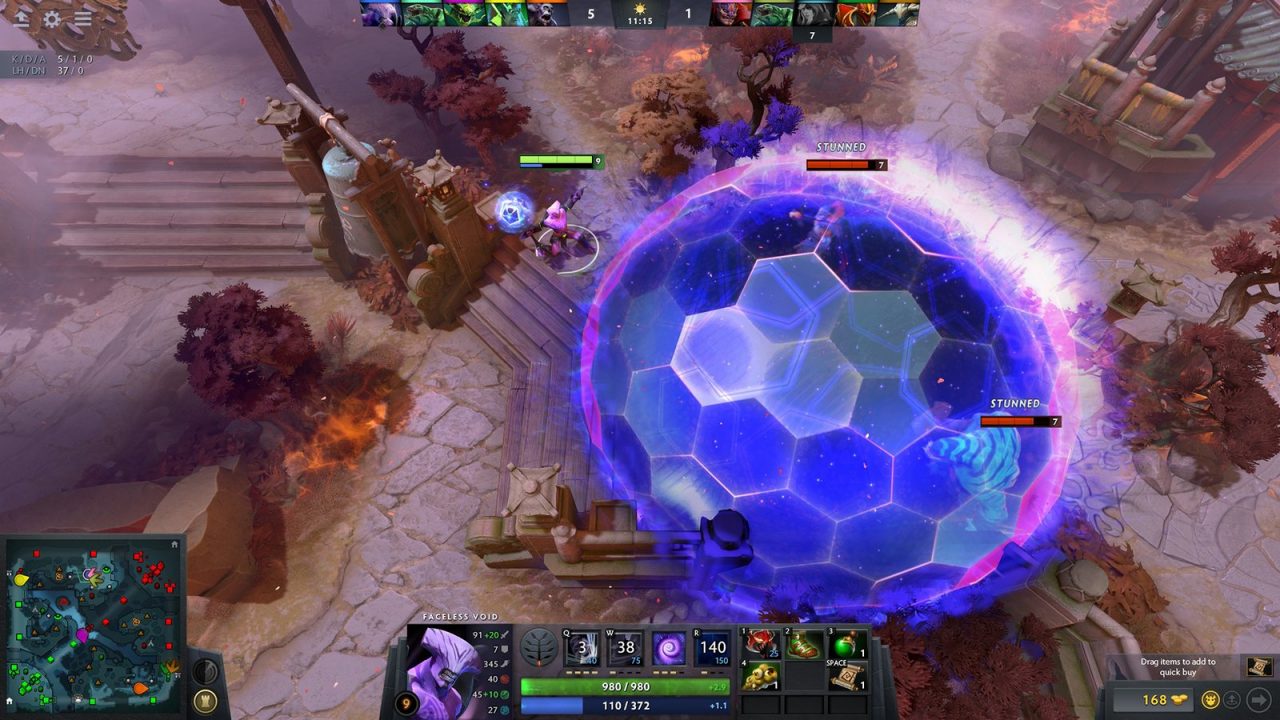
Typical position 1 heroes include Anti-Mage, Phantom Assassin, Juggernaut, Wraith King, Faceless Void and Spectre. The common mistake for new carries is fighting too early. A carry who joins every skirmish at minute ten may never reach the items that make them strong.
Position 2: The Mid Laner
The mid laner plays alone in the middle lane, where they get solo experience and gold. Mid heroes typically reach key levels quickly and are expected to turn that into pressure across the map.
- Laning: win a one-on-one matchup, control the lane, and contest power runes that spawn near the middle river.
- Tempo: after reaching an important level or item, move to other lanes to help secure kills. This is often what decides the early game.
- Bottle and runes: many mid players buy a Bottle, which stores runes and provides sustain.
Mid heroes vary widely. Some are tempo heroes that want to fight early (Storm Spirit, Puck, Queen of Pain), while others are secondary carries that scale well (Shadow Fiend, Templar Assassin, Invoker). Sniper and Viper are often recommended to beginners because their kits are straightforward.
Position 3: The Offlaner
The offlaner goes into the hardest lane, usually with the position 4 support, against the enemy carry and hard support. Their early goal is not necessarily to win the lane outright but to survive, gain experience and disrupt the enemy carry’s farm.
Offlaners are often the team’s initiators. In the mid game they start fights with abilities that stun or catch several enemies, and they build items that make them durable or give the team auras and utility. Classic offlaners include Axe, Tidehunter, Mars, Centaur Warrunner, Dark Seer and Underlord. A good offlaner absorbs attention: if three enemies focus them in a fight and they survive long enough, their carry is free to deal damage.
Position 4: The Soft Support
The position 4 player is the more active of the two supports. They start the game with the offlaner, but they are free to leave the lane early to roam: walking to other lanes to set up kills, especially in the middle lane. Soft supports also stack neutral camps for their cores, contest runes and pressure the enemy safe lane.
Because position 4 usually has a bit more gold than position 5, they may build items that start fights or protect allies. Heroes like Earth Spirit, Tusk, Earthshaker, Mirana and Rubick fit the role because they can move around the map and create opportunities with their abilities.
Position 5: The Hard Support
The hard support sacrifices nearly all farm for the team’s benefit. In the safe lane, they protect the carry, harass the enemy offlaner and “pull” neutral creeps into the lane wave to control where the creeps meet. Throughout the game they handle much of the team’s utility spending:
- Vision: buying and placing Observer Wards and using Sentry Wards to reveal enemy wards and invisible heroes.
- Consumables: Smoke of Deceit for coordinated ganks, and healing items for the lane partner.
- Saving allies: using disables or utility items such as Force Staff and Glimmer Cape to keep cores alive.
Hard supports often have the lowest net worth in the game and die the most, and that is fine if their sacrifices keep the cores alive. Good beginner choices include Crystal Maiden, Ogre Magi, Lion, Witch Doctor and Dazzle. These heroes have strong disables or heals that stay useful even with little gold.
Why Dota Roles Are More Fluid Than League’s
Players coming from League of Legends often notice that Dota roles feel less rigid. Several features of the game explain this:
- No dedicated jungler. Dota has neutral camps, but no summoner spell like Smite and no jungle item that defines a role. Supports stack and pull camps, carries farm them in the mid game, and every player can take jungle gold when lanes are empty.
- Lanes can be shuffled. Teams sometimes put three heroes in one lane, send a support to a different lane, or switch lane assignments to avoid a bad matchup.
- Heroes cross positions. Many heroes can be played in several positions depending on items and the draft. A hero who is a position 4 one game might be a mid or offlaner the next.
- Farm priority changes. If the carry falls far behind and the mid is ahead, the team may shift resources toward the stronger hero. Positions are a plan, not a contract.
- Items open new roles. A support with a good item timing can turn into a significant damage threat, and some cores build utility items that are traditionally considered “support items.”
League has also loosened its roles over time, but its game systems, such as the dedicated jungle item, the support gold item and, since 2026, position-specific Role Quests, tie players more firmly to their positions. Our League of Legends roles guide covers those positions if you want to compare.
How the Five Positions Work Together
A typical game plan illustrates how the numbers fit together. In the first minutes, the safe lane duo (1 and 5) focuses on getting the carry farm, the offlane duo (3 and 4) tries to make that hard, and the mid (2) fights for runes and levels. Around the middle of the early game, the mid and position 4 begin rotating to create kills, while the offlaner gains enough levels to start fights. In the mid game, the cores take towers and farm the space that the team controls, while supports ward ahead and hunt enemy supports. By the late game, the carry is the main damage source, the offlaner initiates, the mid provides burst or control, and the supports keep vision and save allies.
Draft matters. A team with five greedy heroes will struggle early, and a team with no late-game carry may run out of power if the game drags on. A balanced draft covers initiation, damage at different stages of the game, disables and the ability to push towers.
Choosing Your First Position
Each position teaches a different part of Dota:
- Position 5 teaches map awareness, vision and patience. It is forgiving for beginners because simple support heroes contribute even when behind.
- Position 1 teaches last hitting and efficient farming, the core skill of the game.
- Position 2 teaches laning one-on-one and rune control, but you get less help.
- Position 3 teaches surviving pressure and initiating fights.
- Position 4 teaches movement around the map and timing.
Pick one position and a few heroes for it, and play them repeatedly. Learning what your role needs at each stage of the game will improve your results more than learning dozens of heroes.
Common Mistakes by Position
Carry: fighting before your key items are ready, or farming for too long while the team loses towers.
Mid: never leaving the lane, which wastes the experience advantage.
Offlane: dying repeatedly in lane instead of playing for experience and safety.
Soft support: roaming so often that the offlaner is left alone with no help.
Hard support: forgetting wards and Smoke, or standing in the front of fights without escape tools.