What Is a MOBA? A Beginner’s Guide to the Genre
What a MOBA is, where the name came from, how a match unfolds from laning to the final push, and how today's major MOBAs differ from each other.
MOBA stands for multiplayer online battle arena. It is one of the most played genres in PC gaming, and the basic idea fits in one sentence: two teams each control a single hero per player, fight across a fixed map, and try to destroy a large structure inside the enemy base.
This guide explains how the genre works, where its name came from, how a typical match plays out, and how the big games you are likely to try (League of Legends, Dota 2, Smite 2, Pokémon Unite and Deadlock) put their own spin on the formula.
The Core Ingredients of a MOBA
Almost every MOBA is built from the same set of parts, even if the names change from game to game.
- Two teams. The classic format is five against five. Deadlock uses six players per side, and many mobile and casual modes are smaller.
- A symmetrical (or nearly symmetrical) map. Each team has a base in an opposite corner, joined by lanes, usually three: top, middle and bottom.
- Heroes. Every player picks one character before the match starts. League of Legends calls them champions, Smite calls them gods, and Pokémon Unite simply uses Pokémon. Each typically has three basic skills plus a powerful ultimate.
- Creeps or minions. Waves of weak AI units spawn from each base at regular intervals and walk down every lane. Killing them is the main source of gold and experience.
- Towers and structures. Each lane is guarded by defensive towers (called turrets in League) that shoot at enemies in range. You normally have to break them in order before you can reach the base.
- Experience and levels. Heroes start weak and gain experience from nearby kills. Levels unlock and upgrade abilities.
- Gold and items. Gold earned during the match buys items that add stats or new effects. Nothing carries over to the next game.
- A win condition. Destroy the enemy’s main structure: the Nexus in League, the Ancient in Dota 2, the Titan in Smite, the Patron in Deadlock. Pokémon Unite is the notable exception, with a points-based goal system instead.
The jungle is the other common feature. Between the lanes lie paths and clearings filled with neutral monsters that belong to neither team. They give gold and experience, and the strongest ones grant team-wide rewards, which makes them objectives worth fighting over.
MOBA, ARTS, Hero Brawler: Where the Name Came From
The genre grew out of custom maps made by players inside real-time strategy games. In 2002 a modder known as Gunner created Aeon of Strife, a custom map for StarCraft in which each player controlled one powerful unit while waves of AI units fought across lanes. A year later, Warcraft III modders built on the idea with Defense of the Ancients, better known as DotA, first made by a creator called Eul and later developed as DotA Allstars by Steve “Guinsoo” Feak and then IceFrog.
Because these games came from strategy titles, early names leaned on that heritage. You will still see “action real-time strategy” (ARTS) used, and Valve described Dota 2 that way around its 2013 release.
The term MOBA took hold after Riot Games released League of Legends in late 2009 and described the game’s genre as a multiplayer online battle arena. As League grew into one of the most played games in the world, its label spread with it. Blizzard called Heroes of the Storm a “hero brawler.” Today MOBA is the standard umbrella term, and it is the one we use throughout this site.
How a MOBA Match Plays Out
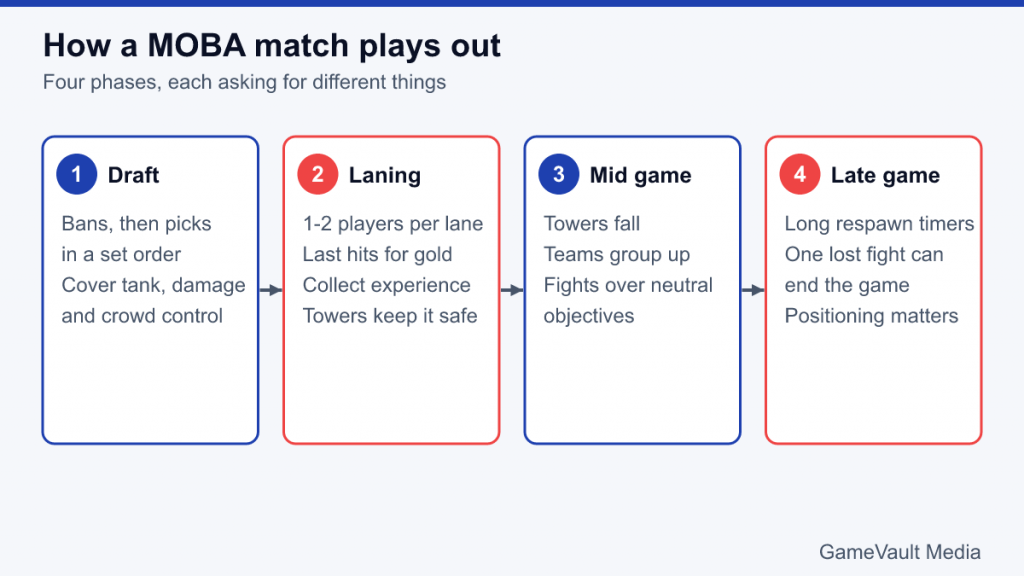
A match moves through recognizable phases, and each asks for different things.
Picking heroes
In ranked modes, hero selection is usually a draft with bans, where each side removes some heroes from the pool and picks in a set order. Picking well means covering several needs at once: someone durable to start fights, someone to deal sustained damage, someone with crowd control (stuns, slows, roots) and someone to protect allies.
The laning phase
The early minutes are spent in lanes, usually one or two players per lane, with another player roaming the jungle. The goal is to grow stronger than your direct opponent by landing the final blow on minions (the “last hit”) to earn gold, collecting experience, and punishing enemy mistakes. Towers keep this phase fairly safe, because chasing an opponent too close to their tower is dangerous.
The mid game
Once a few towers fall and heroes reach their first major items, the map opens up. Players group, rotate between lanes, and fight over neutral objectives. A team that wins a fight can take a tower or a big monster with little resistance.
The late game
Late in a match, heroes are close to full strength, respawn timers are long, and a single lost fight can end the game. Teams guard the entrances to their bases and look for one decisive engagement. Patience and positioning usually matter more here than raw mechanical skill.
How Matches Are Won
Newcomers often assume the team with more kills wins. Kills help, because they deny the enemy time and give gold, but structures are what end games. A team that trades two kills for a tower is often better off than one that wins a fight and walks away with nothing.
The usual path to victory looks like this:
- Win lanes or at least avoid falling behind.
- Use kills and pressure to take outer towers, which opens the map and gives your team more space to farm safely.
- Secure neutral objectives that grant powerful buffs.
- Break into the enemy base and destroy key structures that make your minions stronger (inhibitors in League, barracks in Dota 2).
- Win one more fight, then push to the main structure and destroy it.
Comebacks are part of the genre. Many MOBAs give extra rewards for killing heroes or structures belonging to the team in the lead, and late-game heroes often scale well enough to turn things around if their team defends patiently.
Roles: Why Five Players Do Five Different Jobs
Because gold and experience are limited, teams divide them up. In League of Legends the standard positions are top, jungle, mid, bottom and support. Dota 2 numbers its positions 1 through 5 based on how much farm each player should get, from the hard carry down to the hard support. Smite and Pokémon Unite have their own versions.
Roles are not strict rules, but they give new players a clear starting job. A support focuses on vision, protecting allies and setting up kills rather than collecting gold. A carry needs gold more than anyone and becomes the team’s main damage source later. Learning one role well is a better first goal than trying to be good at everything.
The Main MOBAs Today and How They Differ
The games below share the same skeleton, but they feel quite different to play.
| Game | Developer | Released | Team size | Camera | Main structure to destroy |
|---|---|---|---|---|---|
| League of Legends | Riot Games | 2009 | 5v5 | Top-down | Nexus |
| Dota 2 | Valve | 2013 | 5v5 | Top-down | Ancient |
| Smite 2 | Titan Forge Games (Hi-Rez) | Free-to-play from January 2025 | 5v5 (Conquest) | Third-person | Titan |
| Pokémon Unite | TiMi Studio Group / The Pokémon Company | 2021 | 5v5 | Top-down | None (points-based) |
| Deadlock | Valve | Announced 2024, still in invite-based testing as of 2026 | 6v6 | Third-person shooter | Patron |
League of Legends
League is the most widely known MOBA and arguably the most approachable of the classic top-down games. Its main map is Summoner’s Rift. Compared with Dota, it has shorter matches on average, a “recall” ability that teleports you home to shop, and no way to kill your own minions.
Dota 2
Dota 2 is Valve’s direct continuation of DotA Allstars, developed with IceFrog. It keeps many of the mod’s more demanding mechanics: you can “deny” your own creeps so the enemy cannot get gold from them, heroes turn at a set speed rather than instantly, items are delivered by a courier, and players can buy back into the match after dying. Every hero is free to play, which is unusual for the genre. Dota is often described as the most complex of the major MOBAs.
Smite 2
Smite, first released by Hi-Rez Studios in 2014, swapped the overhead view for a third-person camera behind your character, so abilities are aimed like in an action game. Its heroes are gods from world mythologies. Smite 2, built on Unreal Engine 5, was announced in January 2024 and became free to play in January 2025. In February 2025 the studio announced it would end development of the original Smite to focus on the sequel.
Pokémon Unite
Pokémon Unite launched in 2021 on Nintendo Switch and later on mobile devices. Instead of destroying a base, teams collect energy from wild Pokémon and score it in the enemy’s goal zones, and the team with more points when time runs out wins. Matches are short, and your Pokémon evolves as it levels during a game, making it a good entry point for younger players.
Deadlock
Deadlock is Valve’s newest take on the genre. It combines MOBA structure (lanes, AI troopers, defensive Guardians and Walkers, a soul-based economy and items) with third-person shooting and lots of movement, including ziplines. Teams have six players, and Valve reduced the main map from four lanes to three in early 2025. Valve officially showed the game in August 2024, and as of 2026 it remains an invite-only test on Steam, so expect mechanics to keep shifting.
Is a MOBA Right for You?
MOBAs reward patience: the first few dozen matches can feel overwhelming. A few things make the start easier:
- Start with tutorials and bot games. League and Dota 2 both include introductory content and matches against AI opponents.
- Pick a small pool of simple heroes. Two or three heroes with straightforward abilities will teach you more than rotating through dozens.
- Focus on one skill at a time. Last hitting, map awareness and knowing when to retreat matter more early than flashy plays.
- Expect long matches. Classic MOBA games commonly run 25 to 45 minutes, so set aside enough time and avoid leaving early.
- Mute when needed. All major MOBAs let you mute chat and pings from other players.
If you enjoy strategy but prefer less mechanical pressure, the related auto battler genre, which grew directly out of a Dota 2 custom game, might suit you better. Teamfight Tactics and Dota Underlords let units fight automatically.
Common Beginner Misconceptions
“Kills are everything.” Structures and objectives decide matches. A player with zero kills who takes towers and lands crucial crowd control can be the most valuable person on the team.
“MOBAs are mostly about reflexes.” Mechanical skill helps, but decision-making (where to stand, when to fight, what to buy) is the bigger factor, especially at lower ranks.
“The genre is all the same game.” League, Dota 2, Smite 2, Pokémon Unite and Deadlock share a skeleton but differ in pace, camera, economy and complexity. If one does not click, another might.