Vision and Warding in MOBAs: Why Map Information Wins Games
How fog of war, wards and true sight work in League of Legends and Dota 2, plus where and when to ward, how to deward and how vision wins objectives.
Most of a MOBA map is hidden most of the time. You can see what your team’s units and structures can see, and everything else is covered by the fog of war. The team that knows more about where the enemy is can take fights it will win, avoid fights it would lose and claim objectives without a contest. Wards are the main tool for creating that knowledge, and good warding is one of the clearest differences between teams that coordinate and teams that do not.
This guide explains how vision works in League of Legends and Dota 2, the ward types in each game, and the practical principles of where and when to ward.
Fog of War: What You Can and Cannot See
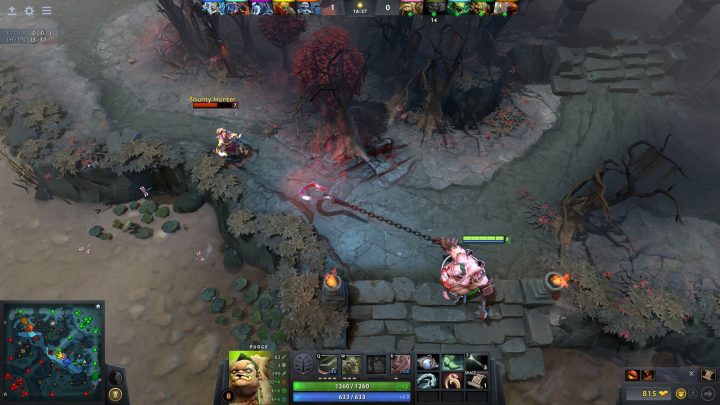
In both games, each team sees only what its own units can see. Heroes, champions, minions, creeps, structures and wards all have a sight radius. Areas outside that radius are covered by fog, and enemy units inside the fog are invisible to you even if they are standing right there.
Several features of the terrain shape vision:
- Brush in League. Tall grass blocks vision from outside. A champion inside a bush can see out, but enemies outside cannot see in unless they have vision inside the bush, which is why brush is central to ambushes and lane trades.
- Trees and high ground in Dota. Trees block line of sight, and units on low ground cannot see up to high ground without help. Dota also has a day and night cycle: most heroes see less far at night, which makes ganks and smokes more dangerous after dark.
- Walls. Terrain walls block sight in both games, so a ward placed on the wrong side of a wall may see much less than expected.
Because enemy positions are hidden, players work with information that is always partly out of date. The skill of vision control is about making that information as fresh and as relevant as possible.
Ward Types in League of Legends
League gives every player access to vision tools, but how they are used depends on role.
| Ward / tool | Source | What it does |
|---|---|---|
| Totem Ward | Stealth Ward trinket | An invisible ward that lasts 90–120 seconds depending on champion level |
| Stealth Ward | Support item upgrades and some other items | An invisible ward lasting 150 seconds |
| Control Ward | Bought in the shop | A visible ward that lasts until destroyed and reveals and disables enemy stealth wards nearby; one placed per player |
| Farsight Ward | Farsight Alteration trinket | A long-range, visible ward with a small sight radius that dies in one hit |
| Oracle Lens | Trinket | Not a ward: a sweeper that reveals and disables enemy stealthed wards around you |
Values are from the official League wiki as of 2026. Stealth Wards and Totem Wards share a placement limit of three per player; placing a fourth removes your oldest. If you place a second Control Ward, the first one disappears.
Typical role patterns:
- Supports do most of the warding. Their starting support item upgrades into a version that provides ward charges, and many swap to Oracle Lens to clear enemy vision.
- Junglers often take Oracle Lens early or mid game to clear wards around objectives and gank paths.
- Laners use the Stealth Ward trinket to protect themselves from ganks, then sometimes swap to Farsight Alteration later in the game for safe long-range scouting.
- Everyone should buy Control Wards. They are cheap, persistent, and help deny the enemy vision in key areas.
Ward Types in Dota 2
Dota 2 has two classic ward items, both bought from the shop with limited stock that replenishes over time.
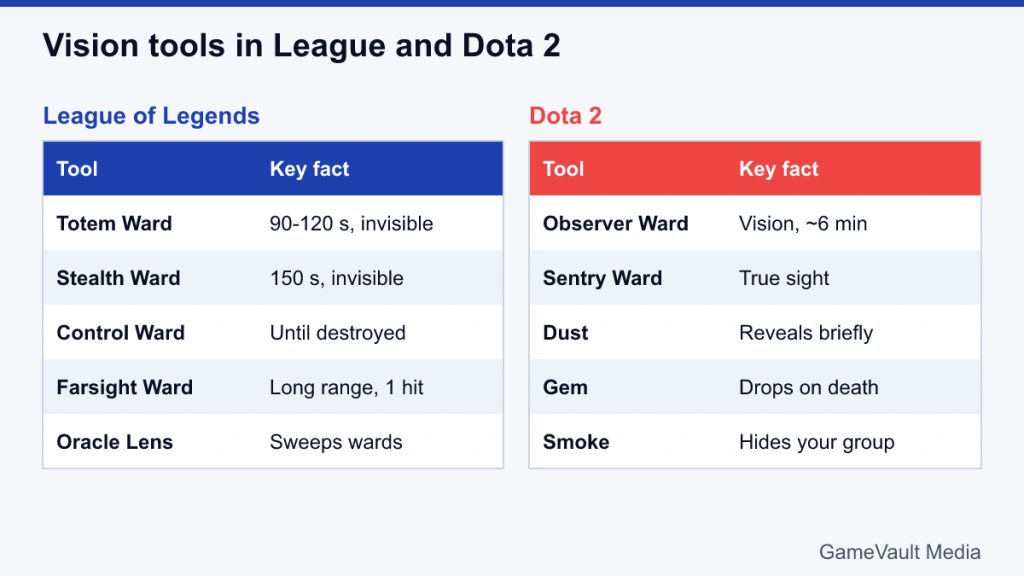
- Observer Ward: an invisible ward that grants a large area of vision for about six minutes. It does not reveal invisible units.
- Sentry Ward: an invisible ward that provides true sight in a radius around it, revealing invisible heroes, invisible wards and other stealthed units. It does not provide normal vision of a wide area in the same way as an Observer.
Other important tools:
- Dust of Appearance reveals invisible enemy heroes in an area for a short time.
- Gem of True Sight gives its carrier permanent true sight in a radius and drops on death, so the enemy can take it.
- Smoke of Deceit makes a group of allied heroes invisible and hidden from the minimap until they come close to an enemy hero or tower, the classic counter to enemy vision when ganking.
Destroying an enemy ward in Dota grants a gold reward, so dewarding is both a way to blind the enemy and a small income source for supports. Since the wards cost gold and the supply is limited, supports in Dota spend a large share of their income on vision.
True Sight and Invisibility
“Seeing” an area and seeing everything in it are not the same. Invisible units, including stealthed wards and invisible heroes, need a special reveal.
In League, Control Wards and Oracle Lens reveal stealthed wards and some camouflaged champions within their radius. In Dota, the concept is called true sight, provided by Sentry Wards, Dust of Appearance, Gem of True Sight, towers and certain abilities. Heroes that rely on invisibility, such as those built around Shadow Blade, become far less effective when the enemy carries true sight.
The practical lesson: if an enemy hero keeps disappearing or you keep getting caught by an invisible opponent, buying detection is not optional.
Where to Ward
Ward placement depends on the game, the map and the moment, but the principles are shared:
- Ward to protect the lane early. In the laning phase, place wards on the paths an enemy jungler or roamer would take to reach you: river entrances, side bushes and jungle entrances near your lane.
- Ward where the next fight will be. Before an objective spawns, vision should already surround it. Wards placed after the fight starts are usually too late.
- Ward the enemy’s routes, not your own base. Deeper wards show enemy movements earlier, though they are riskier to place.
- Ward chokepoints. A single ward at a narrow passage often reveals more useful movement than one in an open area.
- Replace wards before they expire. Timed wards run out. Note when key wards will expire and refresh them, especially around objective timers.
In League, the area around Dragon and Baron is the most contested ground on the map in the mid and late game; our Summoner’s Rift map guide shows the brush and river entrances around these pits. In Dota, vision around Roshan’s lair, the outposts and the high ground before a siege matters most. For Roshan specifically, see our Roshan guide.
When to Ward
Timing matters as much as placement. Common moments to invest in vision include:
- Before objective timers. Roughly a minute before a Dragon, Baron, Voidgrubs or Roshan opportunity, teams begin setting up vision and clearing the enemy’s.
- After winning a fight. When the enemy is dead or retreating, you can walk safely into their jungle to place deep wards.
- When you are ahead. Vision lets you choke the enemy’s jungle and catch players who try to farm.
- When you are behind. Defensive vision helps you see dives coming and pick off overextended enemies.
Dewarding: Denying the Enemy Information
Removing enemy wards is the other half of vision control. A team that clears enemy wards around an objective can start it without being seen, and a team that clears wards near its jungle can farm safely.
- In League, Control Wards and Oracle Lens are the primary dewarding tools. Sweeping an area before an objective is standard practice.
- In Dota, Sentry Wards and Gem of True Sight reveal enemy wards. Experienced supports predict common ward spots and check them with a Sentry.
- Paying attention to the enemy support’s movements helps. If they walked into a spot and left, there may be a ward there.
Dewarding is not just a support task. Junglers clear wards in their path, and laners can drop a Control Ward in the river bush to protect themselves.
Common Vision Mistakes
- Never using the trinket. In League, a trinket sitting at full charges is wasted vision.
- Warding the same spot every game. Predictable wards are easy to clear.
- Facechecking. Walking into an unwarded bush or tree line to see what is there often gets you killed. Use a ward, an ability or a teammate’s vision instead.
- Ignoring the minimap. Wards only help if someone looks at what they show.
- Not buying detection. Against invisible heroes or heavy warding teams, detection pays for itself quickly.
- Leaving all vision to one player. Supports carry the main load, but every player can contribute.
Quick Questions About Vision
How many wards should a support place?
There is no fixed target. In League, a support should rarely sit on full ward charges, and every player should keep a Control Ward on the map. In Dota, supports usually buy wards whenever stock and gold allow, since an Observer Ward in the right place is one of the most cost-efficient items in the game.
Do wards show up on the minimap for my team?
Yes. Allied wards and the vision they provide appear on the minimap for the whole team, which is why one well-placed ward can protect several players at once.
Should carries buy wards?
In League, everyone benefits from buying Control Wards. In Dota, cores rarely buy Observer Wards early, but a core who is about to farm a dangerous area alone can justify one, and anyone can carry Dust or a Sentry against invisible heroes.
Why Vision Matters So Much
Most fights are decided before the first ability is cast, by which team knew more. A team with vision can choose engagements, avoid traps and take objectives quietly. A team without it has to guess, and guessing wrong in a MOBA costs time, gold and sometimes the game. Learning to ward and deward is one of the most reliable ways to improve without needing faster reflexes.