Last Hitting and Denying: How Farming Works in MOBAs
Why the killing blow matters in MOBAs: last hitting, gold and experience from creeps, denying in Dota 2, creep score and how to practice.
Ask an experienced MOBA player what separates a new player from a decent one, and the answer is often not flashy outplays but something duller: farming. In League of Legends, Dota 2 and most of their relatives, the majority of a core player’s gold comes from killing lane minions and jungle monsters, and that gold only arrives if you land the final blow. This skill is called last hitting, and Dota adds a second layer to it called denying. Together they form the backbone of the laning phase.
This guide explains how farming works, why the killing blow matters, why Dota has denies and League does not, and how to practice both skills.
What Is Last Hitting?
Lane creeps (Dota) or minions (League) spawn in waves and walk down each lane, fighting the enemy wave and structures. When one of them dies, the game checks who dealt the killing blow. If an enemy hero or champion did, that player gets a gold reward. If the creep died to another creep, a tower or anyone else, the gold is simply lost.
That rule creates a precise little minigame. You want to attack a creep only when its health is low enough that your attack will finish it, but not so late that an allied creep takes the kill first. Attacking too early pushes the wave without getting gold; attacking too late wastes the opportunity.
Several factors determine the right moment:
- Your attack damage. More damage means you can start attacking a creep with slightly more health left.
- Attack animation. Every hero has a short wind-up before the hit lands. Heroes with a slow animation need to start earlier.
- Projectile speed. Ranged heroes fire projectiles that take time to travel, especially at long range.
- Incoming damage from other creeps. In a busy wave, a creep’s health can drop sharply between the moment you click and the moment your hit lands.
Experienced players internalize all of this until it feels automatic, which is why last hitting is often described as a muscle-memory skill rather than knowledge.
Gold and Experience: Two Different Rules
One point confuses many beginners: gold and experience are distributed differently.
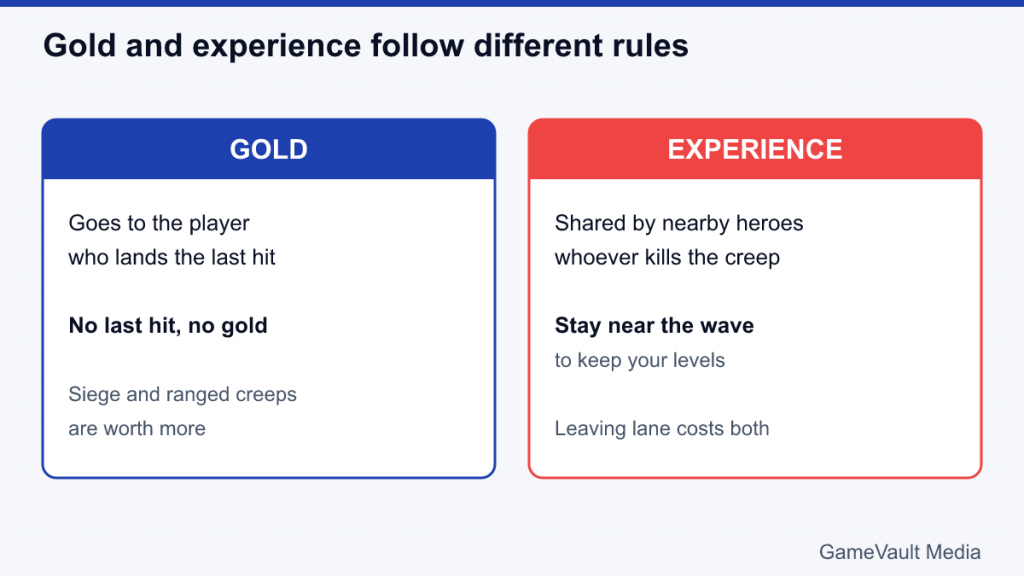
Gold from a lane creep goes to the player who lands the last hit. Some heroes and items grant bonus gold or share gold in specific ways, but the core rule is simple: no last hit, no gold.
Experience is shared among nearby heroes when an enemy creep dies, whoever killed it. If you are standing close enough to a dying enemy creep, you receive experience even if you never touched it. That is why a player who is being bullied out of last hits can still keep up in levels simply by staying near the wave, and why leaving lane costs both gold and experience.
Bigger creeps are worth more. In League, the cannon (siege) minions that appear in some waves give more gold than melee and caster minions. In Dota, ranged creeps and the siege creeps that join waves periodically give more than melee creeps. Prioritizing these is one of the first refinements to basic last hitting.
Creep Score: Measuring Farming Efficiency
Because last hits are so central to income, both games track them. League shows your creep score, or CS, in the top-right corner, counting minions and monsters you have killed. Dota’s scoreboard shows last hits and denies separately as LH/DN.
CS is popular as a self-evaluation tool because it isolates something you control. You can compare your CS at the 10-minute mark across games and see whether you are improving regardless of whether your team won. A useful habit is to note your number at a fixed time each game and try to beat it.
Two cautions apply:
- CS is not everything. Supports are not supposed to take last hits from their carry, and a jungler’s count depends on routes rather than lane skill.
- Missing CS to help win a fight or take an objective can be the right call. CS measures efficiency, not good decisions.
Denying in Dota 2
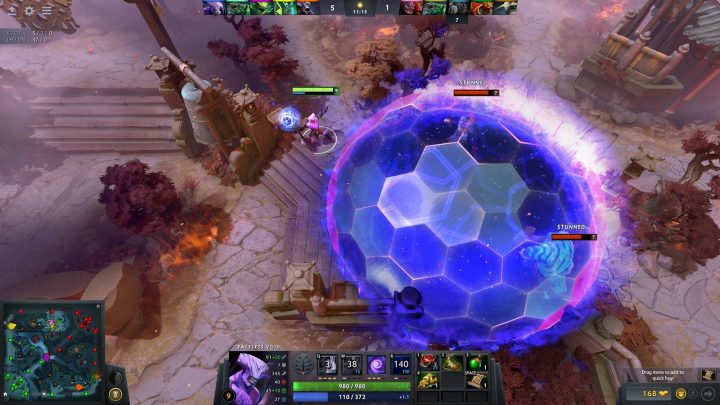
Dota 2 inherited denying from the original Defense of the Ancients map. Denying means killing your own unit so that the enemy cannot. In lane, you can attack your own creeps once they drop below half health. If you land the killing blow on an allied creep, the enemy hero gets no gold from it and receives reduced experience.
Denying has several effects:
- Gold starvation. Every deny is gold your opponent will never get.
- Experience control. Because denied creeps give opponents less experience, a lane where one side denies heavily can create a level advantage, which is especially powerful around key ability levels.
- Wave control. Killing your own creeps slows down your wave’s push, helping keep the creep equilibrium closer to your tower.
Denying is not limited to creeps. In Dota, allied towers can be denied when they are nearly destroyed, which denies part of the enemy’s reward, and heroes affected by certain damage-over-time effects can be denied by allies at low health. These are situational, but they show how deep the concept goes.
The deny shows on the creep as a distinctive exclamation-mark symbol, and denies are tracked on the scoreboard. In the laning stage, a good mid player’s deny count can be nearly as important as last hits.
Why League of Legends Has No Deny
League of Legends does not let players attack their own minions. When Riot built the game around 2009, it streamlined several mechanics players knew from DotA, and League launched without denying, without a courier and without the noticeable turn rate of Dota heroes. The result is a laning phase with fewer separate mechanics to learn.
Without denies, the laning battle in League shifts to other tools:
- Zoning. Threatening damage so the opponent cannot step forward to last hit.
- Wave management. Freezing the wave near your own turret so the enemy has to overextend to farm.
- Trading. Punishing the opponent with abilities when they walk up to take a last hit.
League’s lane is still very much about the killing blow, but the pressure comes from threatening the opponent rather than taking creeps away from them directly. For a broader look at how the two games diverged, our history of the MOBA genre covers the design lineage.
Farming Under Tower
One of the hardest last-hitting situations is when the enemy wave arrives at your tower. Towers deal heavy damage to creeps, and if you do nothing they will kill creeps without giving you any gold.
The general technique is to soften creeps so that the tower shot leaves them at a last-hittable amount. In League this is a well-known pattern: melee minions typically need a couple of tower shots and an autoattack, while caster minions need one or more champion hits before the tower shot. The exact numbers depend on the minions’ scaling and your damage, so the practical approach is to watch the health bar and learn the rhythm in the Practice Tool. In Dota the numbers differ, but the principle of anticipating incoming tower damage is identical.
How to Practice
Last hitting improves fastest with focused repetition, away from the stress of a real opponent.
League of Legends: Practice Tool
League’s Practice Tool, released in patch 7.3, puts you on Summoner’s Rift with cheats available. According to the official League wiki, you can add gold, level up, toggle cooldown refreshes, spawn target dummies and toggle minion spawns. Since the start of 2025 it has also supported multiplayer lobbies with friends. A simple routine is to pick your main champion, go to lane with no enemy and try to get every last hit for ten minutes, then repeat with a target dummy or friend adding pressure.
Dota 2: Demo Hero and lobbies
Dota 2 offers a Demo Hero mode, opened from a hero’s page in the client, which loads you onto the map with cheat-like controls to test the hero, spawn creeps and reset abilities. You can also create a private lobby with cheats enabled, or play bot matches. For last-hitting practice, playing an empty mid lane with creeps running and trying to last hit and deny every unit is the classic drill.
Practice tips for both games
- Start with basic attacks only. Using abilities to farm is a separate skill and can hide weak timing.
- Practice with several heroes. A hero with a slow animation teaches you to anticipate.
- Add items. Damage changes timing, so practice at different stages of the game.
- Track a number. Last hits at a set time, or the percentage of the wave you secured, keeps practice honest.
- Bring it to real games gradually. Focus on farming for a few games without worrying about other aspects of play.
Common Farming Mistakes
- Autoattacking constantly. Hitting creeps at full health pushes the wave toward the enemy tower and makes you an easy target.
- Ignoring the cannon or siege creep. It is worth more than a regular creep and often decides a good lane.
- Fighting while the wave dies. Trading is fine, but losing three or four creeps while you chase rarely pays off.
- Taking support last hits. In both games, supports leave farm to the core in their lane. Our guide to Dota 2 positions explains why farm priority matters.
- Forgetting jungle camps. When the lane is empty, nearby camps are extra income. Farming is not just about lanes.
Why It All Matters
Farming may not be the most exciting part of a MOBA, but every powerful moment depends on it. The item that wins a fight was bought with gold from dozens of last hits, and the level advantage that lets a mid player win a duel may have come from careful denies. Learning to secure creeps efficiently gives you more resources than your opponent before a single fight is taken, which is why it remains one of the first skills players drill and one of the last they stop improving.