From Aeon of Strife to Deadlock: A History of the MOBA Genre
How a StarCraft custom map grew into DotA, League of Legends, Dota 2, Smite, Heroes of the Storm, mobile MOBAs and Valve's Deadlock.
Few genres owe as much to fans as the MOBA. Its defining ideas were not invented in a big studio’s design meeting. They grew inside custom maps that players built with the level editors shipped alongside Blizzard’s strategy games, were refined by a small chain of volunteer designers, and only then turned into commercial products played by millions. This article follows that path, from a StarCraft map in the early 2000s to Valve’s third-person experiment Deadlock, and focuses on the design ideas each step added rather than on the competitive scene.
Before the Name: Strategy Games and Custom Maps
Historians of the genre often point to Herzog Zwei, a 1989 Sega Mega Drive/Genesis strategy game in which each player directs a single transforming unit while other units fight across the map, as an early ancestor. The direct line, however, starts with Blizzard’s StarCraft (1998), which shipped with a campaign editor that let players build their own maps and scenarios.
One of those maps was Aeon of Strife, created in 2002 by a modder known as Gunner. In Aeon of Strife, each player controlled a single powerful hero unit instead of an army, while computer-controlled units marched along three lanes and fought each other. The core skeleton of the MOBA was already visible: one hero per player, AI-driven waves and lanes leading to opposing bases.
Defense of the Ancients: The Warcraft III Era
Blizzard’s Warcraft III: Reign of Chaos arrived in 2002 with a much more powerful World Editor, and Warcraft III already centered on hero units that leveled up and carried items. That made it a natural home for Aeon of Strife’s idea.
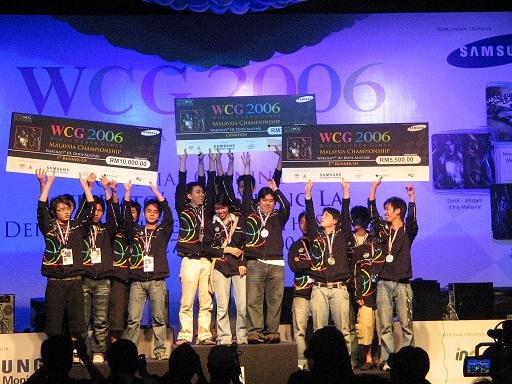
In 2003, a modder known as Eul created the first Defense of the Ancients (DotA), adapting the Aeon of Strife concept to Warcraft III. When Blizzard’s The Frozen Throne expansion launched later that year, Eul stopped updating the map and made its code open, which led to a wave of variants. The one that won out was DotA Allstars, which gathered heroes from many earlier versions into a single map.
From March 2004, Steve “Guinsoo” Feak led Allstars development. During the Allstars years the map settled many of the systems later games would treat as standard, including recipe items that combined smaller components into stronger ones and a powerful neutral boss, Roshan. In 2005, development passed through a designer known as Neichus to IceFrog, who would steer DotA for the rest of its history. Under IceFrog, Allstars became famous for its frequent balance patches, its huge hero pool and mechanics such as denying allied creeps.
DotA’s popularity was enormous for a free mod. By May 2009, the community site dota-allstars.com reported more than 1.5 million registered users. Its success also showed developers that there was a big audience waiting for a standalone version.
The First Commercial Wave: 2009 and 2010
The late 2000s brought several studios trying to turn the DotA formula into a product. Gas Powered Games released Demigod in 2009, often called the first standalone commercial title in the genre.
The breakthrough came from Riot Games. Founded by Brandon Beck and Marc Merrill, Riot brought in Steve Feak as an early designer and released League of Legends on October 27, 2009. League made deliberate changes to lower the barrier to entry: no denying, a recall ability that returned players to base, champions unlocked over time through a free-to-play model, and a polished matchmaking client. Riot also described its game as a “multiplayer online battle arena,” and as League grew, MOBA became the standard name for the whole genre.
S2 Games released Heroes of Newerth in 2010. It stayed close to DotA Allstars in mechanics and feel, offering DotA players a more faithful standalone alternative. The game was eventually shut down in 2022.
Valve, IceFrog and Dota 2
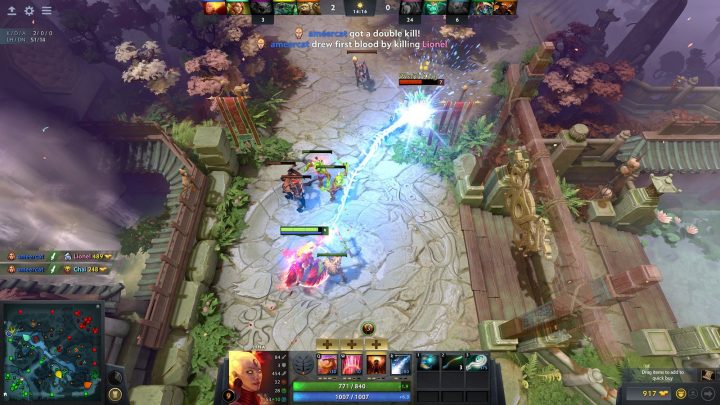
In October 2009, Valve hired IceFrog to lead development of a standalone sequel. Dota 2 was announced in 2010 and kept almost all of Allstars’ mechanics, including denying, the courier, buyback and Roshan, while adding modern graphics and matchmaking. Valve described it as an “action real-time strategy” game, which is why the term ARTS still appears in some sources.
The “Dota” name caused a dispute with Blizzard, which considered the mod part of its own community. In May 2012, the two companies reached an agreement: Valve kept the Dota trademark for commercial use, while Blizzard retained the right to use the name for non-commercial community maps.
Dota 2 was released on July 9, 2013. Valve chose a model where every hero is free, with money coming from cosmetic items instead. In 2015, the game moved to Valve’s Source 2 engine in the “Dota 2 Reborn” update, becoming the first game on that engine. Later updates kept reshaping it: the talent tree system arrived in December 2016 with patch 7.00, and a fourth hero attribute, Universal, joined Strength, Agility and Intelligence in 2023.
New Perspectives: Smite and Heroes of the Storm
By the mid-2010s, designers began testing how far the formula could stretch.
Smite, released by Hi-Rez Studios in 2014, moved the camera from a top-down view to a third-person view behind the player’s character. Abilities became aimed like shooter skills, and the cast was made of gods from world mythologies. Its sequel, Smite 2, was built on Unreal Engine 5 and became free to play in January 2025.
Heroes of the Storm took a different route. It began as “Blizzard DOTA,” a StarCraft II custom map showcased at BlizzCon 2010. After the trademark agreement with Valve, the project became “Blizzard All-Stars” in 2012 and then Heroes of the Storm in October 2013, before releasing on June 2, 2015. Blizzard called it a “hero brawler” and stripped out several genre staples:
- experience was shared by the whole team rather than earned by individuals,
- heroes chose talents as they leveled instead of buying items,
- matches rotated across many different battlegrounds, each with its own objectives.
Blizzard scaled back development in December 2018 and said in July 2022 that it had ended major development, though updates continued. In September 2026, Blizzard surprised players by announcing Xal’atath, the first new hero in about six years, at BlizzCon 2026.
Other experiments came and went in this period, including Epic Games’ Paragon, which was shut down in 2018, and Battlerite, which shrank the formula to small arena fights.
MOBAs Go Mobile
Touchscreens seemed a poor fit for a genre built on precise mouse clicks, but developers adapted. Super Evil Megacorp’s Vainglory (2014) showed that a MOBA could work on tablets and phones. Tencent’s Honor of Kings (2015) became one of the most played games in China, and its international version, Arena of Valor, reached Western markets in 2017.
Mobile MOBAs typically shorten matches, simplify item purchasing with recommended builds, and replace mouse targeting with virtual joysticks. Riot followed with League of Legends: Wild Rift, which began a staggered regional rollout in October 2020. The Pokémon Company and TiMi Studio Group released Pokémon Unite in 2021, which replaced base destruction with a points system based on scoring energy into goal zones.
The Offshoot: Auto Battlers
The genre’s custom-game roots produced another branch in 2019. Dota Auto Chess, a custom game inside Dota 2, let players draft heroes and place them on a board where they fought automatically. It exploded in popularity and inspired Riot’s Teamfight Tactics, Valve’s Dota Underlords and other auto battlers within months. These games borrowed MOBA heroes and the idea of synergy between units but removed direct control entirely. Our guide to how Teamfight Tactics works covers the most popular of them.
Deadlock: Valve’s Third-Person Return
In 2024, playtesters leaked a Valve project called Neon Prime. Valve officially revealed it as Deadlock in August 2024, describing it as in early development. Deadlock mixes MOBA structure (lanes, AI troopers, defensive Guardians and Walkers, a soul-based economy and items) with third-person shooting and movement systems such as ziplines and sliding. Teams have six players instead of five.
Deadlock has continued to change rapidly. Valve reduced its main map from four lanes to three in February 2025 and has added new heroes and major overhauls through 2026. As of October 2026, the game is still an invite-only beta on Steam, with players able to share invites freely.
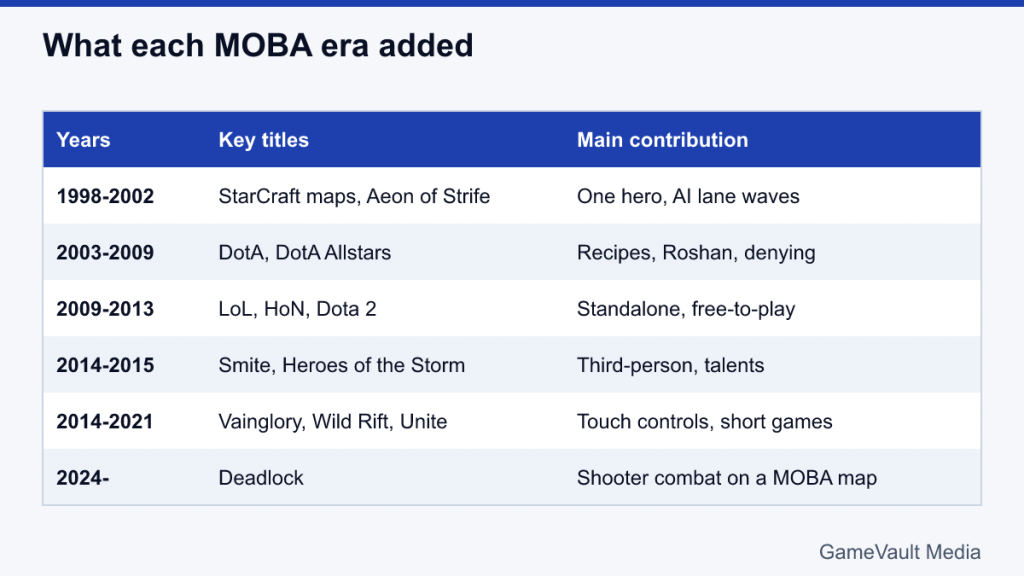
What Each Era Added
| Era | Key titles | Main design contribution |
|---|---|---|
| 1998–2002 | StarCraft custom maps, Aeon of Strife | One hero per player, AI lane waves |
| 2003–2009 | DotA, DotA Allstars | Leveling heroes, recipe items, Roshan, denying, deep hero pool |
| 2009–2013 | League of Legends, Heroes of Newerth, Dota 2 | Standalone clients, matchmaking, free-to-play models |
| 2014–2015 | Smite, Heroes of the Storm | Third-person camera, shared experience, talents, varied maps |
| 2014–2021 | Vainglory, Honor of Kings, Wild Rift, Pokémon Unite | Touch controls, shorter matches, alternative win conditions |
| 2024– | Deadlock | Shooter combat and movement on a MOBA map |
Why the Genre Lasted
Many genres that grew out of mods faded once the novelty passed. MOBAs did not, and their history suggests a few reasons. The core design is endlessly replayable, because each match starts from zero with a new combination of heroes. The games are free to start, removing the biggest barrier for new players. And developers have kept the formula fresh by changing what surrounds the skeleton: camera, team size, economy, map or controls. If you want to see how today’s major games compare at a glance, our beginner’s guide to MOBAs puts them side by side.