How Teamfight Tactics Works: A Beginner’s Guide to TFT
A plain-language guide to a Teamfight Tactics game: eight players, stages and rounds, the shop, star levels, traits, items, health and placement.

Teamfight Tactics, usually shortened to TFT, is Riot Games’ auto battler. It launched as a mode inside the League of Legends client on June 26, 2019, and arrived on Android and iOS in March 2020. It uses League’s champions, but it plays nothing like League. You never control a champion directly. Instead, you build a team on a hexagonal board between rounds, and the fights play out on their own. Your job is to make good decisions: what to buy, what to keep, where to place each unit and when to spend your gold.
This guide explains a full game of TFT from the first round to the final placement. It sticks to the parts that stay the same from set to set, because TFT replaces most of its champions and traits several times a year.
The Basics: Eight Players, One Survivor
Every game of TFT has eight players. Each player starts with 100 health and their own board. In each player-versus-player round, you are paired against one of the other seven players, and your board fights theirs automatically. When you lose a round, you lose health based on how many enemy units are still standing and how far into the game you are. Damage per loss grows as the game goes on, so late losses hurt much more than early ones.
When a player’s health reaches zero, they are eliminated. The order in which players are knocked out determines the final placements, from 8th up to 1st. You do not have to win the whole game for it to be a good result. In ranked play, finishing in the top four is generally treated as a win and earns ranked points, while the bottom four lose points, and higher placements earn more.
Stages and Rounds
A TFT game is divided into stages, and each stage into rounds. The game shows the current round as two numbers, such as 2-1 (stage 2, round 1) or 4-5. Each round has a short planning phase, when you buy units and arrange your board, followed by combat.
- Stage 1 is a short warm-up. You fight computer-controlled monsters (PvE rounds) that drop loot, and you get your first units and items.
- From stage 2 onward, most rounds are player-versus-player. Each stage usually includes a shared draft (the carousel) partway through and ends with a PvE round against monsters that drop items or gold.
- Most sets also give you augment choices a few times per game. Augments are powerful bonuses that change your strategy for the rest of the game.
Precise timings shift slightly from set to set, so it is worth watching the round tracker at the top of the screen, which shows what kind of round comes next.
The carousel
The carousel is a shared draft in which all players walk to a rotating ring of units, each holding an item, and grab one. Players with the lowest health pick first, which gives struggling players a chance to recover. It is one of the main ways to collect a specific item component. Riot sometimes adjusts or reshapes the carousel as part of a set’s theme; for example, the 2026 set Enchanted Wilds paired it with a new Wisp mechanic. The basic idea of a shared draft, with the lowest-health players picking first, has remained a staple of the game.
The Shop, Gold and Leveling
At the start of every planning phase, your shop shows five random champions. Each champion has a cost from 1 to 5 gold; cheaper ones are common and weaker, expensive ones are rare and powerful. You can do three main things with gold:
- Buy champions from the shop to add to your bench or board.
- Reroll the shop for 2 gold to see five new champions.
- Buy experience to raise your level faster. Your level also rises automatically a little each round.
Your level matters for two reasons. First, it sets how many units you can field: one unit per level. Second, it changes the odds in your shop, so higher levels show more expensive champions more often.
You earn gold every round. On top of base income, you gain interest: one extra gold for every 10 gold you hold at the end of a round, up to a maximum of 5 extra gold at 50 gold. You also gain bonus gold for win streaks and loss streaks. This is why good players often sit on a stack of gold instead of spending everything immediately. We will cover economy in more depth in a dedicated guide, but the short version for beginners is: try to save toward 50 gold early, then spend the excess.
Star Levels: Upgrading Units
Champions start at 1 star. Collect three copies of the same champion and they automatically combine into a 2-star version with much higher stats. Combine three 2-star copies (nine total copies) and you get a 3-star champion, which is dramatically stronger again.
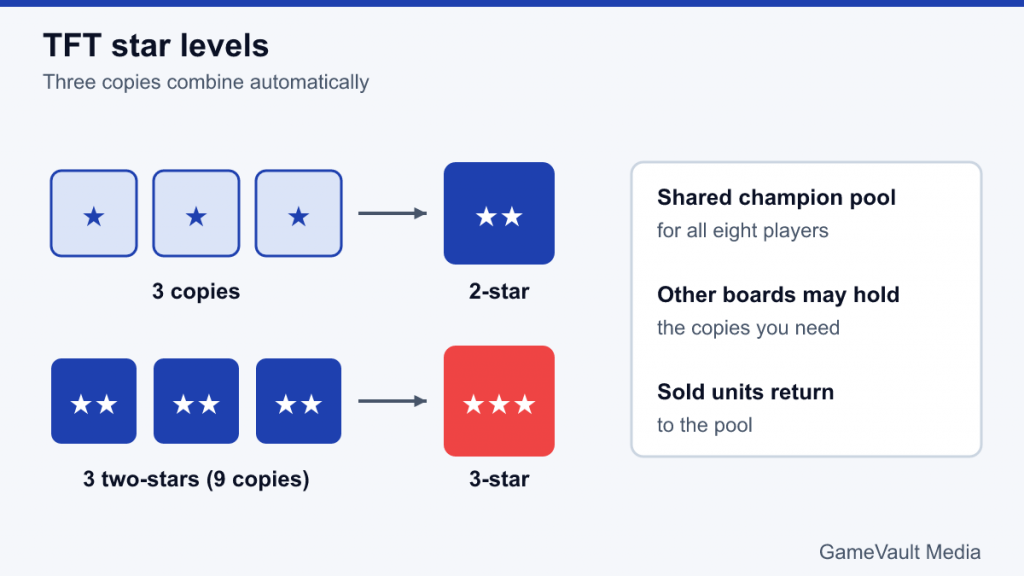
Because all eight players buy from a shared pool of champions, the copies you need may already be on other boards. If three other players are collecting the same champion, your chance of finding copies drops. That is why scouting other boards is useful and why being flexible pays off. Champions you sell go back into the pool.
Your bench, the row below your board, holds extra units you have not placed yet. It has limited space, so selling units you no longer need is part of good play.
Traits: Building Synergies
Every champion has two or three traits. Traits usually come in two kinds: origins, linked to the champion’s theme in that set, and classes, linked to their combat style. When you field enough different champions sharing a trait, that trait activates and grants a bonus. Most traits have several breakpoints, such as 2, 4 and 6 units, and the bonus gets stronger at each one.
Traits are the heart of TFT strategy. A strong board usually combines:
- one or two main traits that boost your primary damage dealer,
- a defensive trait or tanky units to hold the front line,
- a few cheap “splash” traits that activate with only two units.
Only champions on the board count toward traits. Units on the bench do not. Each copy of a champion counts once, so two identical champions do not double a trait.
Items: Components and Completed Items
Items in TFT start as components, basic pieces such as a sword, a bow, a rod or a chain vest. You get them from PvE rounds, the carousel and other set-specific sources. Place two components on the same champion and they instantly combine into a completed item with a much stronger effect. Each champion can hold up to three items.
Choosing which champion holds your items is one of the key decisions. In general, give damage items to the unit you expect to deal most of your damage, and give defensive items to a durable front-line unit. Items cannot be removed from a champion without special tools, though selling a champion returns its items to your bench, so placing items early on a temporary holder is often fine. A dedicated guide later in our series covers items in detail.
Positioning and Combat
Combat starts automatically when the planning timer ends. Each unit moves toward the nearest enemy, attacks, and builds mana to cast its ability when its mana bar fills. You cannot intervene once the fight starts, so everything depends on your setup.
Basic positioning principles:
- Put durable units in the front row so they take hits first.
- Keep fragile damage dealers in the back row, often in a corner.
- Watch for enemy assassins that jump to your back line, and adjust by shifting your carry or surrounding it with tanky units.
- Spread units out against enemies with large area-of-effect abilities.
You can see the boards of the other seven players at any time by clicking their portraits. Checking who you might face next and what they are building is a simple habit that improves results.
How Sets Rotate
TFT reinvents itself regularly. Each set brings a new roster of champions, new traits, a new theme and usually a signature mechanic. In 2025, Riot released Set 14 (Cyber City) in April, Set 15 (K.O. Coliseum) in July and Set 16 (Lore & Legends) in December. In 2026, Set 17 (Space Gods) arrived in April and Set 18 (Enchanted Wilds) in August. Earlier in the game’s life, Riot also released half-step “mid-set” updates, such as Set 3.5 or Set 9.5, that refreshed part of a roster.
Because of this rotation, specific team compositions and champion names become outdated within months. The skills that carry over are economy, reading the shop odds, flexible trait building, item choices and positioning. Riot has also occasionally brought back older sets in limited-time “Revival” events.
A Simple Game Plan for Your First Games
- Do not panic about early losses. Early rounds do little damage. Focus on collecting pairs of champions and building toward 2-star units.
- Pick a direction by the middle of stage 2 or stage 3. Look at your items and the units you have, and choose a set of traits that fits.
- Save toward interest. Keeping 30 to 50 gold gives you steady extra income.
- Level up at sensible times so your board does not fall behind.
- Spend to stabilize if your health drops low; a full bank does nothing if you are eliminated.
- Aim for top four before aiming for first.
Common Beginner Mistakes
Rolling all your gold early. Spending everything on rerolls in stage 2 leaves you without interest and without money when it matters.
Forcing one composition every game. If other players are taking the same champions, or your items do not fit, the plan will struggle. Flexibility wins more games.
Ignoring positioning. The same units can win or lose a fight depending on where they stand.
Leaving units on the bench. Always fill every board slot your level allows before combat begins.
TFT grew out of the same roots as other auto battlers, and its relationship to MOBAs is close: the champions come from League of Legends, and the strategic thinking about roles, frontlines and damage dealers will feel familiar if you have read our guide to the MOBA genre.