What Does a Jungler Do? Jungling Explained
What junglers actually do: Smite and jungle pets in League, clear paths, ganks, objective control, tracking the enemy jungler and Dota's approach.

The jungler is the player on a MOBA team who does not belong to a lane. Instead of standing in front of one opponent for the first fifteen minutes, they roam the space between lanes, killing neutral monsters, appearing in lanes to set up kills, and leading the fight for big objectives. It is often described as the role with the most influence over the early game and also the one with the most decisions to make. If you have ever wondered why your jungler is “never there” or why a game can swing on a single gank, this guide explains what the role involves.
Most of the detail below is about League of Legends, where the jungle is a formal role with its own summoner spell and items. Dota 2 handles the jungle differently, and we cover that at the end.
The Jungle on Summoner’s Rift
On Summoner’s Rift, the jungle is the network of paths between the three lanes, divided by the river into four quadrants. Each team’s half contains the same set of neutral monster camps:
- Blue Sentinel and Red Brambleback, the two buff camps, which grant temporary buffs to the player who kills them.
- Gromp, Murk Wolves, Raptors and Krugs, the regular camps that provide gold and experience.
- Rift Scuttler (Scuttle Crab) in the river, which grants vision and a speed shrine when killed.
On top of these are the epic monsters in the river: Voidgrubs and the Rift Herald on the top side, the elemental dragons on the bottom side, and Baron Nashor later in the game. Our Summoner’s Rift map guide shows where all of these sit relative to the lanes.
Jungle camps respawn after being killed, so a jungler’s income depends on moving efficiently from camp to camp and returning when they come back.
Smite and Jungle Pets
Two pieces of equipment define the League jungler.
Smite is a summoner spell that deals a large chunk of true damage to a monster or enemy minion. Junglers use it to speed up clears and, crucially, to secure the killing blow on contested epic monsters. Since patch 25.09 in 2025, Smite on permanent Summoner’s Rift queues is only available to the player drafted as Jungle and cannot be swapped out, so there is no longer any confusion about who the jungler is.
Every jungler also starts with a jungle companion item. As of 2026 there are three: Gustwalker Hatchling, Mosstomper Seedling and Scorchclaw Pup. The pet follows you through the jungle and gains treats as you clear camps. According to the official League wiki, feeding the pet 15 treats upgrades Smite to Unleashed Smite, which deals more damage and can also be cast on enemy champions for a small amount of damage and a slow. At 35 treats it becomes Primal Smite, which hits nearby monsters as well and adds a passive that depends on the pet:
| Pet | Primal Smite passive | Suits |
|---|---|---|
| Gustwalker Hatchling | Bonus movement speed in brush | Mobile champions and gankers |
| Mosstomper Seedling | A shield with tenacity and slow resistance | Tanks and engage champions |
| Scorchclaw Pup | Burning stacks applied to enemy champions | Damage-focused junglers |
In the 2026 season Riot folded this into the new role quest system, which gives every position a quest that pays out a reward when completed. For junglers, finishing the pet quest also adds bonus movement speed in the jungle and river and extra gold and experience from large monsters. Exact values change from patch to patch, so check the in-game tooltip for current numbers.
Jungle items also discourage junglers from farming lane minions, which keeps them from simply stealing a laner’s gold. Their job is to farm the jungle and influence lanes, not to replace a laner.
Clear Paths: Planning the First Minutes
A jungler’s first few minutes follow a clear path: an order in which they kill camps. The choice determines where they will be on the map at a given time, and that position decides which lanes they can affect.
Common patterns include:
- Full clear. Killing all six camps on your side before doing anything else. It maximizes experience and gold and is popular for champions that are weak early or rely on scaling.
- Early gank route. Clearing three camps quickly and then appearing in a lane at level 3, when laners often have not placed defensive wards yet.
- Start on the side you want to play toward. Junglers often finish their opening on the side of the map where they plan to gank, contest Scuttle Crab, or take Voidgrubs or dragon.
Good junglers plan the route around their own lanes, too. A lane that is likely to win benefits from an early visit, while a lane that will be bullied may need protection. This is why the jungler is often called the player who “plays the map” rather than playing a single matchup.
Ganking: Turning Pressure Into Kills
A gank is a surprise attack on an enemy laner, usually by the jungler arriving from fog of war. Successful ganks give kills, force enemy summoner spells such as Flash, and push the lane in your favor.
Ganks are more likely to work when:
- The enemy laner is pushed far up the lane, away from their turret.
- Your laner has crowd control or damage to follow up with.
- The enemy has used their escape spell recently.
- The approach path is not warded.
Ganks are less likely to work when the enemy is near their own turret, has vision of your approach or has their escape tools available. A failed gank costs time that could have been spent farming, so the jungler constantly weighs the odds. Even a gank that does not kill can be valuable if it forces a Flash or lets your laner take a free turret plate.
Counter-ganking is the defensive version: standing near a lane where you expect the enemy jungler to appear, so you can turn their gank into a fight that favors your team.
Objective Control
Junglers usually lead the team’s approach to epic monsters, both because Smite is needed to secure them and because junglers are already moving around the river. A typical jungler thinks about:
- Dragons. Each drake gives a permanent team buff, and collecting enough gives a dragon soul. See our guide to dragons and Baron Nashor for the full system.
- Voidgrubs and Rift Herald. Early siege objectives on the top side of the river that help take turrets.
- Baron Nashor. The game-deciding mid- and late-game objective.
The jungler’s job is not only to kill objectives but to set them up: pushing the right lanes first, placing vision in advance and calling the team over when the timer approaches. Trading objectives is also part of the craft. If the enemy is taking dragon, the best answer may be to take Voidgrubs on the opposite side rather than fight at a disadvantage.
Tracking the Enemy Jungler and Managing Tempo
The enemy jungler is the jungler’s main rival. Knowing where they are tells you which lanes are safe, which objectives can be taken and where you might invade.
Tracking works by deduction. If you see the enemy jungler at their Red Brambleback at 1:45, you can estimate where they will be next based on common routes. If they show up in bottom lane, the top side of the map is temporarily safe. Junglers and laners share this information through pings and chat.
Tempo describes who is ahead in using time well. A jungler who has cleared camps and has a lane ready to gank is ahead in tempo over one who just backed with nothing to do. Some common tempo concepts:
- Invading: entering the enemy jungle to steal camps while the enemy jungler is known to be elsewhere.
- Cross-mapping: if the enemy jungler ganks one side, you take objectives or camps on the other.
- Resetting on time: going back to shop when camps are down, so you return as they respawn.
Our article on League of Legends roles explains how the jungler fits with the other four positions, especially the common jungle-mid partnership.
The Jungle in Dota 2
Dota 2 has a jungle full of neutral creep camps on each side of the map, ranging from small camps to ancient camps with much stronger creeps. But unlike League, Dota does not have a dedicated jungle position in standard play today. The camps are a shared resource used in several ways:
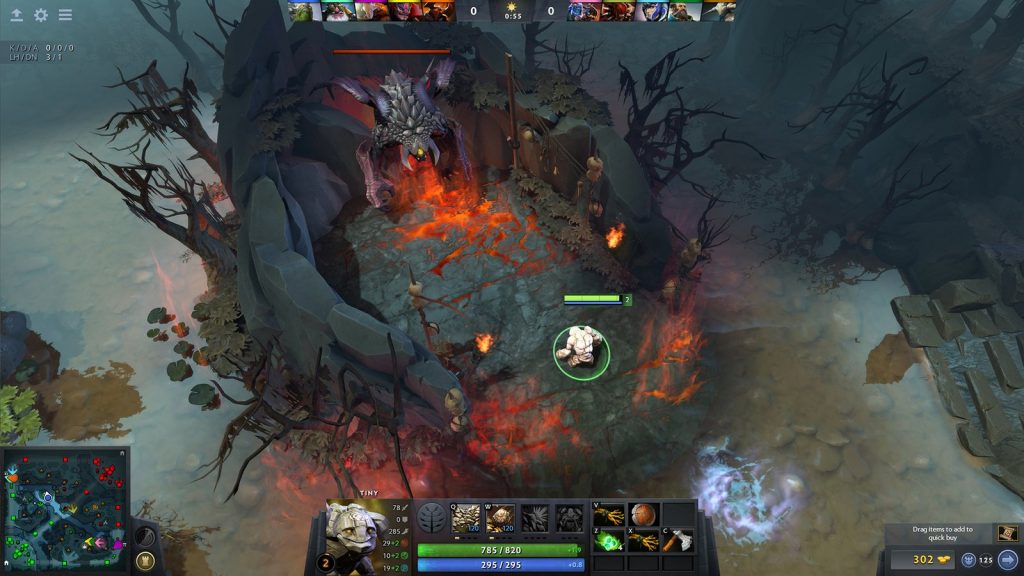
- Cores farm the jungle between lane waves, especially the carry and mid player once laning ends.
- Supports stack and pull camps, using the minute-mark respawn timing to build bigger camps for their cores and to manipulate the lane equilibrium.
- Roaming supports and offlaners fill the ganking role that a League jungler plays, rotating between lanes with Smoke of Deceit and Town Portal Scrolls.
- Neutral camps provide Madstones, used to craft neutral items since patch 7.38.
Dota has had dedicated jungle heroes at various points, and some heroes can still farm the jungle very early, but a hero who never laned has generally been treated as a niche or high-risk strategy rather than a standard role.
Common Jungler Mistakes
- Farming without a plan. Clearing camps is necessary, but a jungler who never shows up in lanes or at objectives leaves the team without its main source of early pressure.
- Forcing bad ganks. Ganking a lane that is pushed under its own turret wastes time.
- Ignoring objective timers. Dragons and Voidgrubs that spawn uncontested are free for the enemy.
- Not tracking the enemy jungler. If you do not know where they are, neither do your laners.
- Tilting over lanes. Junglers are often blamed for losing lanes. Focus on the lanes you can actually help.
Jungling rewards players who like making decisions and reading the whole map. It is demanding, but it is also the role where a single good plan can tilt a game before most players have finished their first item.