League of Legends Roles Explained: Top, Jungle, Mid, Bot and Support
What each of League's five positions does in the early, mid and late game, which champions usually fill them, and how the roles work together.
Every standard match of League of Legends on Summoner’s Rift puts five players on each team, and over the years those five players have settled into five fixed jobs. The client calls them Top, Jungle, Middle, Bottom and Support. Players shorten Middle to “mid,” and the Bottom player is often called the “ADC” (attack damage carry) or simply “bot.” None of this is enforced by the game rules in a strict sense, but the matchmaking system, the item shop and, since the 2026 season, the Role Quest system are all built around it.
If you are new to MOBAs in general, start with our beginner’s guide to the genre. This article assumes you know what lanes, minions and turrets are, and focuses on what each League position is actually responsible for.
Why League Has Five Fixed Roles
Summoner’s Rift has three lanes and a jungle between them. Gold and experience come mostly from killing minions, and a minion wave only gives full value to one or two champions at a time. If two players share a lane, both earn less experience. Over many seasons, players discovered that the most efficient split was:
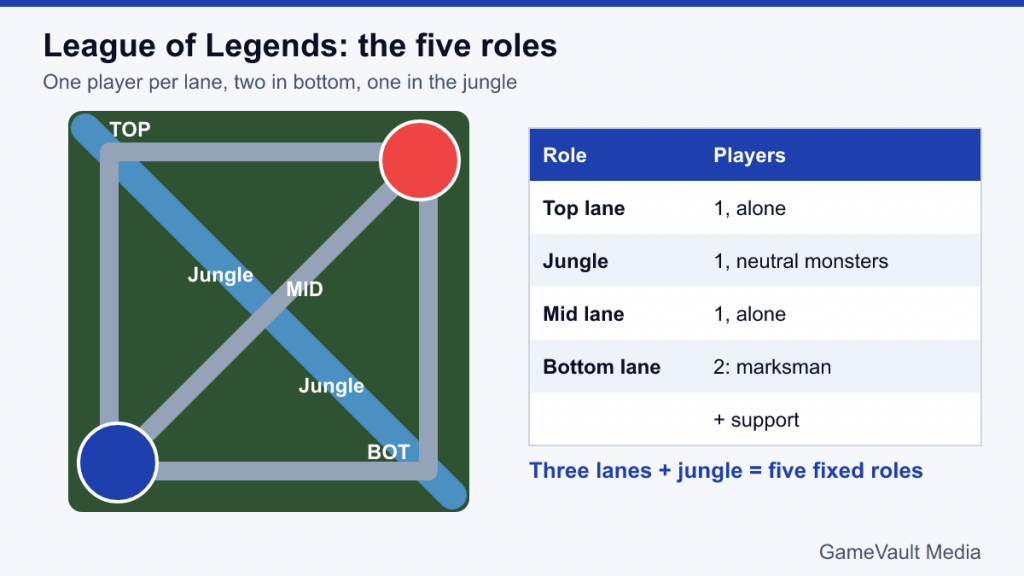
- one player alone in the top lane,
- one player alone in the middle lane,
- two players in the bottom lane (a damage dealer and a support who takes very few minions),
- one player in the jungle, living off neutral monsters and helping lanes.
That structure became so standard that Riot built it into the game. In draft and ranked queues you choose a primary and secondary position before queuing (or “Fill” if you are happy to play anything), and the matchmaker assigns each player a role. Starting with patch 26.1 in January 2026, your assigned position in champion select also determines which Role Quest you receive: a lane-specific goal that grants a reward when completed. Position swaps have to be made during champion select, and casual modes such as Swiftplay do not use Role Quests.
Top Lane
The top lane is the longest walk from the bottom side of the map, where the Dragon pit sits, and top laners are often left alone for long stretches. That isolation shapes the role.
Early game
Top laners usually face one opponent for the first 10 to 15 minutes. The lane is a duel: trading damage, managing the minion wave and watching for the enemy jungler. Because help arrives less often than in other lanes, top laners need to be self-sufficient and patient. Losing the lane badly can leave you weak for the rest of the game.
Mid and late game
As the game opens up, top laners often do one of two things. Some act as the team’s frontline, starting fights or absorbing damage. Others “split push” in a side lane, pressuring turrets so the enemy has to send someone to answer. The Teleport summoner spell is a common pick because it lets a top laner join fights elsewhere on the map.
Typical champions
Fighters and tanks dominate: juggernauts such as Darius and Garen, skirmishers such as Fiora and Jax, and tanks such as Shen and Malphite. Under the 2026 Role Quest rules, completing the top lane quest raises the champion’s level cap from 18 to 20 and grants bonus experience, which suits a role that thrives on solo growth.
Jungle
The jungler is the only player who does not have a lane. Instead, they clear camps of neutral monsters scattered between the lanes, gaining gold and experience from them, and move around the map to influence fights.
Core jobs
- Clearing camps. Junglers take the Smite summoner spell, which deals heavy damage to monsters, and start the game with a jungle pet item that helps them clear. Feeding the pet by killing monsters upgrades it and strengthens Smite.
- Ganking. A “gank” is an ambush on an enemy laner, ideally when the enemy has pushed too far forward. A successful gank gets a teammate ahead.
- Objective control. Junglers are expected to secure epic monsters such as dragons, Voidgrubs, the Rift Herald and Baron Nashor, because Smite gives them the best chance to land the final hit.
- Tracking the enemy jungler. Knowing where the opposing jungler is tells your lanes when they are safe to play aggressively.
Typical champions
Divers like Vi, Jarvan IV and Hecarim, tanks like Sejuani and Amumu, and assassins like Evelynn and Kha’Zix are all common. The role demands map awareness more than mechanical outplays, which is why many players describe it as the “decision-making” position.
Middle Lane
The mid lane is the shortest lane, running straight through the center of the map. Because it is short, the mid laner can reach either side of the map quickly, and the lane itself is relatively safe to stand in since your turret is never far away.
Early game
Mid laners face one opponent and try to win their lane through trades, minion control and good timing. Once they push their wave into the enemy turret, they gain a window to move (“roam”) to top or bottom lane, or to help the jungler at the river.
Mid and late game
Mid laners are often a team’s main source of magic damage or burst. In teamfights, they look for a chance to land key abilities on several enemies or delete a priority target. The 2026 mid lane Role Quest rewards fighting and pushing with a free boots upgrade and an empowered recall that sends the player home faster, reinforcing the role’s emphasis on moving around the map.
Typical champions
Mages such as Annie, Syndra, Lux and Viktor are classic mid picks, alongside assassins such as Zed, Akali and Talon. Some skirmishers, like Yasuo, also appear here.
Bottom Lane (Marksman)
The bottom laner is usually a marksman: a ranged champion who deals sustained damage through basic attacks. Marksmen start weak and fragile but grow into one of the most dangerous threats on the map once they complete several items. That is why the position is called a “carry”: the team protects it so it can carry the late game.
Early game
Bot lane is a two-versus-two lane. The marksman’s main job is to collect as many minion kills (creep score, or CS) as possible while staying alive, trading with the enemy pair when their support creates an opening. The Dragon pit sits near the bottom river, so bot lane fights often decide early dragons.
Mid and late game
Marksmen want to stay at a safe distance in fights and attack whatever is closest and reachable, while the rest of the team protects them. Positioning is everything: a well-positioned marksman can win a teamfight on their own, and a badly positioned one dies in a second. In the 2026 season, finishing the bot lane Role Quest grants extra gold and moves boots into a separate slot, effectively giving the marksman room for one more item.
Typical champions
Ashe, Caitlyn, Jinx, Ezreal, Miss Fortune and Kai’Sa are standard. Occasionally mages or other ranged champions play bot lane, which is why some players prefer “Bottom” or “bot carry” over the older term “ADC.”
Support
The support shares bot lane with the marksman but deliberately takes almost no minion gold. Instead, supports buy a dedicated support item that generates gold over time and upgrades as they earn it. Their value comes from enabling others.
Core jobs
- Protecting or enabling the carry in lane through heals, shields, crowd control or threat of engagement.
- Vision. Supports place most of the team’s wards and clear enemy wards, especially around dragons and Baron. The 2026 support quest reduces the cost of Control Wards once completed.
- Roaming. After the laning phase, supports often move with the jungler to set up vision and catch enemies.
- Starting or stopping fights with crowd control.
Typical champions
Riot’s class system divides most supports into two groups. Enchanters such as Soraka, Janna, Sona and Lulu heal, shield and buff allies. Catchers and engage tanks, such as Blitzcrank, Morgana, Leona, Thresh and Braum, lock enemies down. Some mages, like Xerath or Zyra, also play support and focus on poke damage.
How the Roles Work Together
Roles are not isolated. The best teams lean on a few classic partnerships.
Bot lane duo
The marksman and support function as a single unit. A common pattern is pairing a support’s strength with a marksman’s: an engage support like Leona with a marksman who follows up with heavy damage, or an enchanter like Soraka with a marksman who wants to trade over a long lane phase. Communication between the two matters more than in any other lane.
Jungle and mid
Because mid is central, the mid laner and jungler are often the first to meet in the river. If the mid laner has pushed their wave, they can move first to help the jungler fight for a scuttle crab or defend against an invasion. In return, the jungler ganks mid to give their laner the advantage. Teams with strong jungle-mid coordination tend to control the river, and controlling the river means controlling objectives.
Top and jungle
Top laners rely on the jungler for help since the lane is far from other teammates, and early Voidgrubs and the Rift Herald spawn on the top side. A jungler who plays near a strong top laner can secure those objectives more safely.
The team as a whole
A balanced team composition usually includes a frontline (often top or jungle), magic and physical damage (usually mid and bot), crowd control and some form of protection (often support). Drafting five champions who all deal the same type of damage, or who all want to fight at the same range, makes the team easy to counter with items.
Which Role Should You Play First?
There is no wrong answer, but each role teaches a different skill:
| Role | What it teaches | Common beginner challenge |
|---|---|---|
| Top | Laning, trading, wave control | Falling behind with little help |
| Jungle | Map awareness, timers, objectives | Deciding where to go next |
| Mid | Lane fundamentals and roaming | Pressure from both junglers |
| Bottom | Last hitting, positioning in fights | Dying quickly when caught |
| Support | Vision, teamwork, reading fights | Feeling less impactful early |
Many players start with support because the champions are forgiving and you learn the game by watching teammates. Others start with mid or bot to practice last hitting. Whatever you choose, pick one main role and one backup, and learn two or three champions for each. Queuing as Fill early on is a fine way to experience every position, but sticking to one role is the faster route to improvement.
Common Misunderstandings About Roles
“The support is the least important player.” Supports have less gold, but vision and crowd control decide many fights. A good support often has the most influence on whether the team wins objectives.
“The jungler should gank every lane all the time.” Ganks only work when the lane state allows it. Junglers also need to farm and take objectives, and a failed gank wastes valuable time.
“Roles are fixed forever.” Riot changes the incentives every season. In 2026, Feats of Strength were removed and replaced by Role Quests, and the balance of what each position gets has shifted before and will likely shift again. The broad jobs described here, however, have stayed remarkably stable for more than a decade.