Summoner’s Rift Map Guide: Lanes, Jungle, Turrets and Inhibitors
A tour of Summoner's Rift: the three lanes, river, jungle quadrants, turret tiers, plates, inhibitors and the Nexus, and why each structure matters.

Summoner’s Rift is the main map of League of Legends and the one used for ranked play, normal Draft games and professional matches. It has been redesigned visually several times since the game launched in 2009, but its basic shape has stayed the same: two bases in opposite corners, three lanes connecting them, a river cutting across the middle, and a jungle filling the space in between. Learning that layout is one of the fastest ways to make better decisions, because almost every choice in League comes down to where you are on the map and where the enemy might be.
This guide walks through the map from the outside in. If you are still learning which player goes where, read our guide to League’s five roles alongside it.
The Big Picture: Two Bases and a Diagonal
The blue side base sits in the bottom-left corner and the red side base in the top-right. Each base contains a fountain (where players spawn, heal and shop), three inhibitors and the Nexus. The map is close to symmetrical along the diagonal between the two bases, so any spot on one side has a mirrored counterpart on the other. That symmetry is why neither side has a large built-in advantage, and why players talk about the map in terms like “their top-side jungle” or “our bot-side river.”
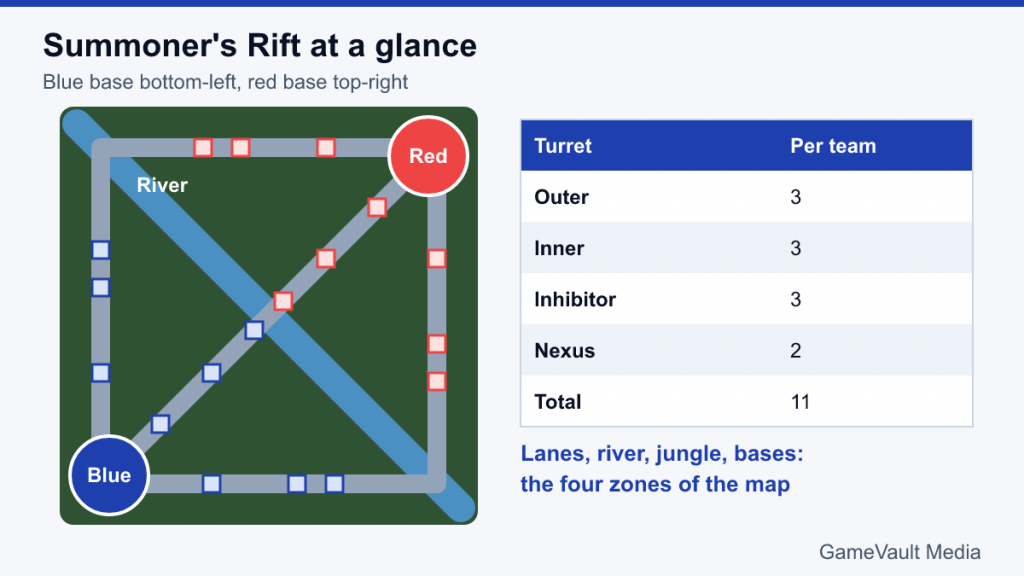
The map can be divided into four zones:
- Lanes: three paths where minion waves march.
- River: the diagonal channel between the bases, running from the top lane to the bottom lane and passing through the middle lane.
- Jungle: the walled areas between lanes, filled with neutral monster camps.
- Bases: each team’s fortified corner.
The Three Lanes
Top lane runs up the left side and across the top of the map. Bottom lane mirrors it along the bottom and right. Middle lane runs diagonally through the center and is the shortest route between bases.
Because the side lanes bend at a corner, they are long, and a player in top or bottom lane can be far from help. Middle lane is short, which makes it easier to escape to your turret and easier to walk to other parts of the map. That geometry is the reason mid laners are expected to roam and top laners are expected to be self-sufficient.
Minion waves
Minions spawn from each Nexus and walk down all three lanes. According to the official wiki, as of the 2026 season the first waves spawn at 0:30 of game time and then every 30 seconds, with the interval shortening to 25 seconds from 14:00 and to 20 seconds from 30:00. A standard wave contains three melee minions and three caster minions, with a siege (cannon) minion added periodically: every third wave early in the game, more often later on. Minions fight anything hostile they meet, and they are the main source of gold and experience in lane.
Where the two waves meet determines how safe a lane is. A wave pushed toward your turret lets you farm safely; a wave pushed toward the enemy turret lets you leave lane or take turret damage, but exposes you to ganks.
Brush
Tall grass, called brush, lines parts of every lane and the river. Units inside brush cannot be seen by enemies outside it unless the area is revealed by a ward or other vision. Brush is used to hide before an ambush, to make enemy skillshots harder to aim, and to break an enemy’s line of sight while escaping.
The River and the Jungle
The river divides the map into a top half and a bottom half. It contains two important pits: the Dragon pit on the bottom side and the Baron pit on the top side. Early in the game, the top pit hosts Voidgrubs and later the Rift Herald before Baron Nashor takes it over at 20:00. A neutral crab, the Rift Scuttler, wanders the river and gives gold, experience and a vision shrine when killed.
The jungle is split into four quadrants, two belonging to each team. Each quadrant contains several neutral camps:
- Blue Sentinel and Red Brambleback: buff camps that grant a temporary buff to the champion who kills them. Blue speeds up cooldowns and restores mana; red adds a burning, slowing effect to attacks and grants health regeneration.
- Gromp, Murk Wolves, Raptors and Krugs: smaller camps that give gold and experience.
Walls separate the camps and create narrow paths and chokepoints. Some champions can dash or jump over walls, which makes the jungle a natural place to escape or ambush. The jungle is also where most vision fights take place, since wards in jungle entrances tell you which way enemies are coming from.
The map changes during a game
Summoner’s Rift does not stay the same for the whole match. After the second elemental drake is killed, the map transforms into an Elemental Rift based on the element of the third drake: Infernal, Mountain, Ocean, Cloud, Hextech or Chemtech. The changes add or remove terrain, brush or special plants. Separately, Baron Nashor’s first spawn corrupts parts of the map in a change Riot introduced in 2024. Knowing which rift you are on helps you predict new paths and hiding spots.
Turrets: Three Tiers per Lane
Each team has 11 turrets on Summoner’s Rift: three in each lane, plus two guarding the Nexus.
| Turret | Number per team | Position |
|---|---|---|
| Outer turret | 3 | Furthest forward in each lane |
| Inner turret | 3 | Middle of each lane, closer to the base |
| Inhibitor turret | 3 | At the base entrance, protecting each inhibitor |
| Nexus turret | 2 | In front of the Nexus |
Turrets must be destroyed roughly in order: a turret is protected until the one in front of it in the same lane has fallen. Turrets attack the first enemy unit that enters range, prioritizing minions over champions, but they immediately switch to an enemy champion who attacks an allied champion nearby. That rule is what makes diving under a turret risky and makes “tower diving” a coordinated team play rather than a solo one.
The Nexus turrets are special: they respawn a few minutes after being destroyed, so a team that takes them but fails to finish the Nexus may have to break them again.
Turret Plates and the First Turret
Lane turrets are covered with plates, five per turret, shown as segments on the health bar. Destroying a plate gives gold to the champion who broke it and nearby allies. When champions damage plates, the turret gains a short defensive buff called Bulwark, which rewards a team that commits several players to a quick push.
The plating rules changed significantly with patch 26.1 in January 2026. In earlier seasons, plates existed only on outer turrets and fell off at 14:00. As of 2026:
- Plates were added to inner and inhibitor turrets as well as outer turrets (Nexus turrets have none).
- Outer turret plates are no longer removed at 14:00. Instead, outer turrets become weaker and plate gold declines from around minute 11.
- Lane turrets can grow Crystalline Overgrowth if left alone, causing extra true damage when an enemy champion attacks them.
The first turret destroyed in a game also grants bonus gold to the players involved. First turret and early plates matter because gold is shared with nearby allies and arrives early, when every item component makes a difference. Destroying an outer turret also opens up the map: the enemy loses a safe zone, and your team gains access to more of their jungle.
Inhibitors and Super Minions
Behind each inhibitor turret sits an inhibitor, one per lane. Destroying one has a powerful effect: the enemy team’s minion waves in that lane start including a super minion, a very durable unit that deals heavy damage to structures. If all three inhibitors fall, the waves include two super minions per lane.
Inhibitors are not permanent losses. Each one respawns 5 minutes after being destroyed, and super minion production stops shortly before that. This makes taking an inhibitor a timed advantage: a team that knocks one down has a few minutes of extra pressure to take Baron, another inhibitor or the game.
Super minions are one of the main reasons that late-game fights near a base are so dangerous for the defenders. While the attacking team regroups, super minions push toward the defending base on their own, forcing someone to clear them.
The Nexus
The Nexus is the structure that ends the game. It stays invulnerable while either Nexus turret is still standing, and it also stays protected until at least one inhibitor is down. If an inhibitor respawns while the Nexus is being attacked and the other conditions are no longer met, the Nexus becomes invulnerable again. That rule has saved many games and is worth remembering whenever you are defending a long siege.
Destroying the Nexus wins the match, regardless of kills, gold or anything else. Every other structure on the map is a step toward this one.
Reading the Map: Practical Tips
Knowing the layout only helps if you use it. A few habits make the map work for you:
- Glance at the minimap every few seconds. If enemy laners disappear from the minimap, assume they may be heading toward you.
- Track where the waves are. A wave crashing into your turret means you can recall without losing much; a wave pushing toward your base is lost gold and possibly a lost plate.
- Think in halves. If the enemy jungler appears in bottom lane, the top half of the map is temporarily safer for your team.
- Use brush and river entrances. Wards at river entrances and key jungle paths give the most information for the effort.
- Play toward objectives. Before a dragon or Baron spawn, push lanes on the same side of the map so your team can move first.
Common Beginner Mistakes on Summoner’s Rift
Chasing into the fog. Following a low-health enemy into unwarded jungle often leads straight into the rest of their team.
Ignoring side lanes in the late game. Minion waves that reach your base can take turrets and inhibitors on their own, especially if super minions are involved.
Diving a full-health turret alone. Turrets hit hard, and they switch targets the moment you attack an enemy champion under them.
Forgetting inhibitor timers. If you destroy an inhibitor and walk away, it will be back in 5 minutes. Use the window.
Summoner’s Rift rewards players who understand its geometry. Once the lanes, river, jungle and structures stop being unfamiliar shapes and start being a set of routes and timers, you will notice that you make better decisions without thinking about it. For a broader overview of how MOBA maps work across games, see our beginner’s guide to the genre.