Dragons and Baron Nashor in League of Legends: Epic Monsters Explained
How League's elemental drakes, Dragon Soul, Elder Dragon and Baron Nashor work as of 2026, what they give and why teams fight over them.
Kills win fights, but objectives win League of Legends games. The two most important neutral objectives on Summoner’s Rift live in opposite halves of the river: the Dragon pit on the bottom side and the Baron pit on the top side. The monsters that spawn there give rewards strong enough to swing a match, and much of the game’s mid and late stages revolve around setting up to take them or deny them.
This guide explains what each epic monster does, when it appears and how teams turn it into a win. Timers and numbers are given as of the 2026 season and come from the official League of Legends wiki and Riot’s patch notes; Riot adjusts these regularly, so small details may shift. For a broader tour of the map, see our Summoner’s Rift guide.
Elemental Drakes: Small Buffs That Stack
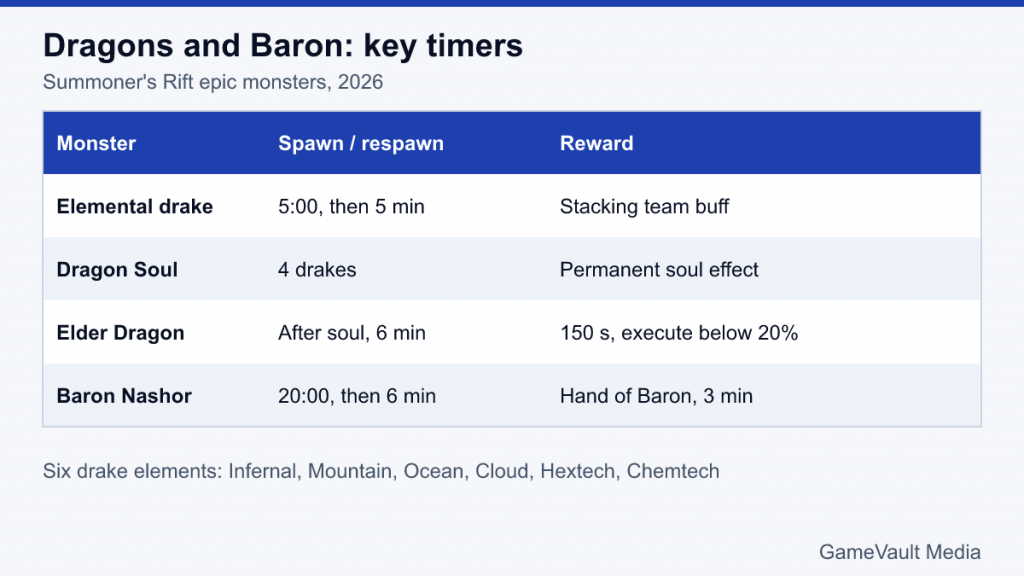
The first drake spawns in the Dragon pit at 5:00. After it is killed, the next one spawns 5 minutes later. Each drake belongs to one of six elements, and each element grants a permanent, stacking team buff called Dragon Slayer to the team that kills it:
| Drake | Team buff (summary) |
|---|---|
| Infernal | Increased attack damage and ability power |
| Mountain | Increased durability for long fights |
| Ocean | Health restoration over time after taking damage |
| Cloud | Bonus movement speed and reduced slow effects |
| Hextech | Faster ability cooldowns and attack speed |
| Chemtech | Tenacity and stronger healing and shielding |
Each individual drake buff is modest, but they are permanent and they accumulate. A team with three drakes is noticeably stronger in every fight for the rest of the game.
The Elemental Rift
The first two drakes are different random elements. After the second drake dies, the third drake’s element is chosen from those not yet seen, and the map transforms into the matching Elemental Rift. From then on, every drake has that element. The rift changes terrain and vegetation: some versions open new paths through walls, others add brush or special plants. Teams that know which rift is coming can plan their fights around it.
Catch-up for the team behind
Drakes include a built-in comeback mechanic. A team that already has more drake stacks deals reduced damage to the next drake, which makes it harder for a team that is already ahead to take every one uncontested. Patch 26.1 in January 2026 increased this reduction, along with making drakes tougher and raising the gold they give.
Dragon Soul
The first team to kill four drakes earns a Dragon Soul matching the rift’s element. Souls are much stronger than individual drake buffs and last for the rest of the game:
- Infernal Soul: attacks and abilities trigger an explosion around the target.
- Mountain Soul: after a few seconds without taking damage, champions gain a shield.
- Ocean Soul: damaging enemies restores health and mana over time.
- Cloud Soul: bonus movement speed, boosted after casting an ultimate.
- Hextech Soul: damage shocks enemies with chaining bonus damage and a slow.
- Chemtech Soul: extra damage and damage reduction while below half health.
Because only one team can earn soul, the third and fourth drakes are often contested heavily. When one team reaches three drakes (“soul point”), the other team usually has to fight for the next one or accept that the enemy will get a permanent advantage.
The Elder Dragon
Once a team has secured its fourth drake and the soul, the Dragon pit stops spawning elemental drakes. Instead, the Elder Dragon spawns, with a 6-minute timer, and respawns 6 minutes after each kill.
Killing it grants Aspect of the Dragon to every living member of the team for 150 seconds. While it is active:
- Damaging enemies sets them on fire, dealing true damage over a short time.
- Enemy champions brought below 20% of their maximum health are executed instantly.
The execute is the reason Elder fights are so decisive. A team with Elder can win a teamfight it would otherwise lose, because enemies who would normally escape on low health simply die. The buff is lost on death, so the team holding it wants to fight immediately rather than wait.
Baron Nashor
The Baron pit has a schedule across the game. Voidgrubs appear there early and the Rift Herald later, but the main event is Baron Nashor, which spawns at 20:00 and respawns 6 minutes after being killed. In 2025 Riot had pushed Baron’s first spawn to 25:00; patch 26.1 moved it back to 20:00 and lowered its toughness at that earlier point in the game.
Hand of Baron
Killing Baron grants Hand of Baron to every living teammate for 3 minutes. It provides:
- bonus attack damage and ability power,
- an empowered recall, letting champions return to base much faster,
- an aura that dramatically strengthens nearby allied minions, making them tougher and better at damaging structures.
Baron’s real power is the minion buff. Empowered waves can break turrets and inhibitors with little help, which forces the defending team to respond in several lanes at once. A team with Baron typically recalls quickly, buys items and then pushes multiple lanes with empowered minions, creating pressure the enemy cannot cover everywhere.
Corrupted Rift
Baron’s first appearance also changes the map. Parts of the terrain become corrupted, and the jungle’s blue and red buff camps and the river Scuttle Crab take on stronger, permanently corrupted forms with different rewards. It is a visible signal that the game has entered its later stage.
Comeback rules
As of 2026, Baron’s rewards are partly global and include extra experience when the team that is behind takes it. This gives a losing team a real reason to attempt Baron if the enemy is caught out of position.
When to Take Epic Monsters
Epic monsters take time to kill and leave the team exposed while doing it. Taking one at the wrong moment can be worse than ignoring it. Common signs that it is a good time:
- Numbers advantage. After winning a fight or catching an enemy alone, the enemy cannot contest with five players.
- Lane priority. If your laners have pushed their waves forward, they can move to the objective first, while the enemy must choose between catching their waves and joining.
- Vision control. Wards around the pit and the clearing of enemy wards make it hard for the enemy to see your setup or attempt a steal.
- Spawn timing. Arriving early, before the monster spawns, lets you set up vision and positions.
- Smite available. The jungler’s Smite deals large damage to monsters and is the main tool for securing the final hit.
Signs that it is a bad time include enemy champions missing from the map with no information on them, your jungler’s Smite being on cooldown, or low health and mana across your team.
Contesting and Stealing
The team without priority has options too. They can trade objectives, taking turrets or a different monster while the enemy is busy. They can try to start a fight while the enemy is damaging the monster, hoping to win while their opponents are low. Or they can try to steal it, using Smite or high-damage abilities to land the final hit. Steals are dramatic but unreliable; most of the time, the better choice is to deny the setup earlier by contesting vision.
How Objectives Turn Into Wins
An epic monster is only as valuable as what a team does with it. A few common patterns:
- Drakes are long-term investments. Each one makes every future fight slightly easier, and soul makes them much easier.
- Baron is a short-term siege tool. The 3-minute buff should be spent pushing structures, ideally inhibitors.
- Elder is a fight-winner. The team with Elder should look for a decisive teamfight before it expires.
A common beginner mistake is to take Baron and then go back to farming the jungle without using the buff. Another is to fight for a drake when the enemy is already in position and has better vision. Objective play is about timing and preparation more than raw strength.
Objectives also tie into roles. Junglers carry Smite and are expected to manage timers, bottom lane sits nearest the Dragon pit, and top laners often help with early Voidgrubs and the Herald. Our roles guide explains how each position contributes.
An Example Objective Timeline
To see how these pieces fit together, picture a fairly typical game. The first drake spawns at 5:00, and the team whose bottom lane has pushed its wave and whose jungler is nearby takes it. Five minutes later the second drake appears; after it falls, the map turns into, say, the Hextech Rift, and every remaining drake will be Hextech. Meanwhile, the top side has hosted Voidgrubs and then the Rift Herald, both useful for breaking turrets early.
At 20:00, Baron Nashor replaces the Herald in the top pit. Now the map has two big timers to track. If one team is at three drakes, the other team faces a hard choice: contest the soul drake on the bottom side or trade by taking Baron on the top side. Many mid-game decisions come down to exactly this kind of trade, and the team that reads the timers earlier usually gets the better deal.
Once a soul is claimed, the Elder Dragon takes over the bottom pit. From that point on, games often end quickly: an Elder kill followed by a won fight frequently leads directly to an inhibitor, Baron or the Nexus.
Frequently Asked Questions
Does killing a drake give gold? Yes, but the main reward is the permanent buff. Patch 26.1 raised drake gold and experience, though the stacking buffs remain the reason to fight over them.
Can both teams get a Dragon Soul? No. Only the first team to four drakes earns a soul, and the pit then switches to the Elder Dragon for the rest of the game.
What happens to Hand of Baron if I die? You lose it. Only living teammates receive it when Baron dies, and dying removes it, which is why teams with Baron should avoid risky fights unless they are clearly ahead.
Who should take the last hit? Usually the jungler with Smite, since Smite’s burst of damage is the most reliable way to secure the kill against a steal attempt.