League of Legends for Beginners: The First Things to Learn
New to League of Legends? Learn what matters first: picking champions, abilities, summoner spells, farming, recalling, map awareness and objectives.

League of Legends has a reputation for being hard to get into, and it is partly earned. There are more than 170 champions, hundreds of item interactions, and a map full of monsters and structures that all matter. The good news is that you do not need to learn everything at once. This guide puts the fundamentals in a sensible order.
The basic shape of a match is simple: two teams of five start in opposite corners of Summoner’s Rift, three lanes connect the bases, and the goal is to destroy the enemy Nexus. Everything else is a means to that end.
Start With the Tutorial and Bot Games
When you create an account, League pushes you into a three-part tutorial on Summoner’s Rift. According to the official League wiki, the current version dates from the 2018 season and is split into stages that unlock one after another:
- Welcome to League teaches movement, attacking and using abilities on a simplified, single-lane version of the map.
- Power Up covers leveling abilities, moving between lanes and gaining experience against a bot team.
- Shop for Gear explains how gold is earned from minions, monsters and champions, and how to buy items.
Do not skip these even if you have played another MOBA. They are short, they introduce League’s specific controls, and finishing them grants rewards that help you unlock champions early on.
After the tutorial, Co-op vs. AI games are the safest place to practice. Bots are predictable, nobody is judging your performance, and you can try a new champion without the pressure of letting human teammates down.
Choosing Your First Champions
The roster is huge and some of the most popular picks are also the most mechanically demanding. A few principles help:
- Pick a role first. League’s standard positions are Top, Jungle, Mid, Bottom and Support. Each asks different things of you, and our guide to League of Legends roles explains them in detail. Choose the one that sounds most fun and stay there for a while.
- Favor simple kits. Champions with straightforward abilities, such as clear point-and-click effects or forgiving area spells, let you focus on the game around you rather than on difficult combos.
- Learn two or three champions, not twenty. Knowing your own champion’s damage, cooldowns and weaknesses is worth more than a shallow familiarity with many.
- Read the champion’s class. Riot sorts champions into classes such as tanks, mages, marksmen and fighters. Our breakdown of champion classes shows what each class is good at and which role it usually fills.
The free champion rotation also lets you try champions before you spend currency on them.
Abilities, Leveling and Summoner Spells
Every champion has a passive and four active abilities. By default the actives are bound to Q, W and E for the basic abilities and R for the ultimate. Champions gain levels by earning experience, up to level 18, and each level gives you one skill point to put into an ability. Ultimates can be leveled at 6, 11 and 16, which is why level 6 is often a moment when fights in lane suddenly become more dangerous.
- Read your abilities before the game. Know which one is your escape, which one deals the most damage and which one controls enemies.
- Follow a skill order. Most champions want one basic ability leveled first. The client’s recommended pages give a reasonable default.
- Remember the ultimate. New players often forget to use R entirely. Use it whenever a fight starts and it is available.
Summoner spells are two extra abilities you choose before the match, bound to D and F by default. They are separate from your champion and have long cooldowns. The most important ones to know as a beginner are:
- Flash, a short instant teleport used to escape or to close distance. Almost every champion takes it.
- Smite, required for junglers, which damages monsters and is used to secure big objectives.
- Ignite, which deals damage over time to an enemy champion and reduces healing.
- Teleport, which lets you travel back to lane or to allied structures; common in the top lane.
- Heal and Exhaust, popular in the bottom lane for protecting the marksman or shutting down a key enemy.
If you are unsure, take Flash plus the spell the client suggests for your role. When an enemy uses Flash, remember it: that player cannot escape the same way for several minutes.
Farming: Where Your Gold Comes From
Gold buys items, and items make your champion stronger. The single biggest source of gold for most roles is killing minions, the small units that march down each lane in waves. The catch is that you only receive gold if your attack lands the killing blow, a technique called last hitting. Standing near dying minions gives experience but not the gold.
The number of minions you have killed is your creep score, shown as CS in the top-right of the screen. Beginners often have very low CS because they focus on fighting the enemy champion and ignore the wave. A few practical tips:
- Watch the minion health bars and attack just before they would die.
- Learn your champion’s attack animation; slow attackers must start their attack earlier.
- Do not autoattack minions at random. Pushing the wave too fast drags it towards the enemy turret, where you are vulnerable.
- Use the Practice Tool, a solo mode on Summoner’s Rift, to rehearse last hitting without opponents.
Supports are the exception: they earn gold mainly through their starting support item, so they should leave last hits to their lane partner.
Recalling and Shopping
You can only buy items at your fountain, so you have to go home periodically. Recall, bound to B, sends you back to base after an eight-second channel; the official wiki notes that taking damage or being crowd-controlled interrupts it. Recall from a safe spot, ideally out of enemy sight, not in the middle of a lane while an opponent is watching.
The best moments to recall are:
- When you have enough gold for a meaningful item or component.
- When you are low on health or mana and would otherwise risk dying.
- Right after you push a minion wave into the enemy turret, so you lose as little farm as possible.
As for what to buy, the in-game shop’s recommended items are a solid starting point. Rather than memorizing builds, try to understand why an item is recommended: does it add damage, durability, mana or speed? Always buy boots fairly early, and pick up a Control Ward when you have spare gold.
Map Awareness: The Habit That Saves Lives
Most deaths in low-level games happen because a player did not notice enemies coming. The minimap shows every enemy champion your team can see, and glancing at it every few seconds is the single most valuable non-mechanical skill in the game.
- Missing enemies. If your lane opponent disappears, they may be walking to another lane or waiting in a bush.
- The enemy jungler. If you saw them on the opposite side of the map a few seconds ago, you can play more aggressively. If you have not seen them in a while, be careful.
- Pings. Use the danger and “enemy missing” pings to warn teammates, and respect them when others use them.
Vision matters just as much. Everyone starts with a trinket that places a temporary Stealth Ward. Placing it in a bush or river entrance near your lane gives you early warning of ganks. Our Summoner’s Rift map guide makes it clearer where wards are most useful.
Objectives: How Games Are Actually Won
Kills feel good, but they are not the win condition. Games are won by destroying structures: turrets, then inhibitors, then the Nexus. Kills matter because they give gold and create windows to take those structures. A frequent beginner mistake is chasing a low-health enemy across the map while a turret sits undefended.
Beyond structures, Summoner’s Rift has epic monsters, including the elemental dragons on the bottom side of the river and Baron Nashor later in the game, that give teamwide rewards. You do not need to master their timers yet, but when your team wins a fight, the next sensible step is often to take a turret or an epic monster rather than run back to farm.
A simple rule of thumb: after a fight goes well, ask “what can we take now?” before anything else.
Game Modes for New Players
League offers several ways to play while you learn:
| Mode | What it is | Why it helps beginners |
|---|---|---|
| Co-op vs. AI | Five players or bots against computer-controlled bots | Low pressure; ideal for learning a champion |
| Swiftplay | A faster normal mode on Summoner’s Rift where you pick champion and role before queuing | Shorter games with quicker progression |
| Normal Draft | Standard unranked Summoner’s Rift with pick and ban phase | Teaches draft without ranked stakes |
| ARAM | All Random All Mid on a single-lane map | Lots of fighting and exposure to many champions |
Swiftplay, announced by Riot in November 2024 and released in 2025 as a replacement for the older Quickplay queue, starts champions at a higher level with extra gold and speeds up objectives so games end sooner. ARAM will not teach you laning or jungling, but it is excellent for learning what dozens of champions actually do.
When Can You Play Ranked?
League gates ranked play behind several requirements. As of 2026, the official League wiki lists them as:
- Summoner level 30 or higher.
- At least 20 champions owned.
- At least 10 full normal games played on Summoner’s Rift.
There are two ranked queues. Ranked Solo/Duo lets you play alone or with one partner, while Ranked Flex accepts groups of different sizes. At the start you play a set of placement games that determine your initial tier.
Common Beginner Mistakes
- Fighting in the enemy’s minion wave. Minions deal significant damage early, so trading while standing in them often loses the trade.
- Diving under turrets. Turrets hit hard in the early game. Unless the enemy will die very quickly, stay out of range.
- Never recalling. Staying in lane with low health and a full wallet leaves you vulnerable and weaker than you should be.
- Chasing kills too far. You lose farm and experience, and you may run into enemies you could not see.
- Tilting. Losing streaks happen to everyone. Muting toxic chat, taking breaks and focusing on one habit per game keeps progress steady.
A Simple Learning Order
If you want a checklist, focus on one item at a time across several games before moving to the next:
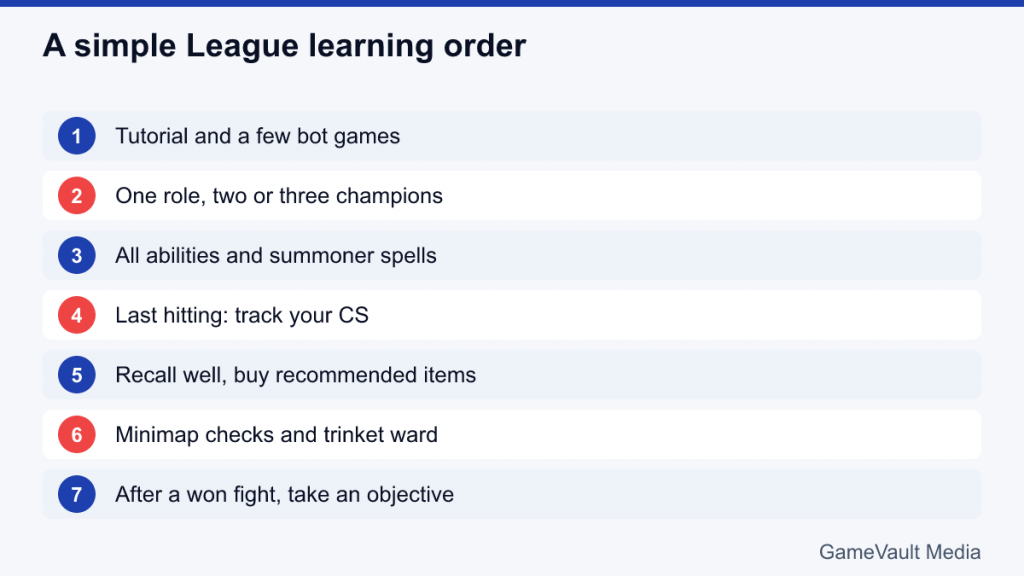
- Complete the tutorial and a few bot games.
- Pick one role and two or three champions to learn.
- Use all your abilities, including your ultimate, and learn your summoner spells.
- Improve your last hitting and track your CS at the end of each game.
- Recall at good moments and buy the recommended items.
- Check the minimap every few seconds and place your trinket ward.
- After winning a fight, look for a turret or objective to take.
None of these steps require exceptional reflexes, only repetition. Once they feel natural, you will have room for wave management, jungle tracking, itemization and team fighting.