Pokémon Unite Explained: Scoring, Roles and Basics
How Pokémon Unite works: scoring Aeos energy in goal zones, evolving during a match, Unite Moves, the five battle types and the 10-minute format.

Pokémon Unite is the Pokémon series’ take on the MOBA genre, and it changes the formula in one big way: there is no enemy base to destroy. Instead, two teams of five collect energy from wild Pokémon and dunk it into the opposing team’s goal zones, like a mix of a MOBA and a sports match. The team with more points when the timer runs out wins. Matches are short, controls are simple, and it runs on a Nintendo Switch or a phone, which makes Unite one of the most approachable games in the genre.
This guide explains how a match works, how Pokémon grow and evolve, what Unite Moves are, and how the five battle types fit together. If MOBAs in general are new to you, our explainer on what a MOBA is covers the shared vocabulary.
The Basics: What Pokémon Unite Is
Pokémon Unite was developed by TiMi Studio Group, part of Tencent Games, and is published worldwide by The Pokémon Company. It launched on Nintendo Switch on July 21, 2021, and on Android and iOS on September 22, 2021. It is free to start, with optional in-game purchases, and supports cross-platform battles between Switch and mobile players.
The game has been a large success by download numbers, passing 200 million downloads across platforms by July 2024, according to Wikipedia’s summary of official announcements. Its roster has grown well beyond its launch lineup, with new Pokémon added regularly.
The key facts of a standard match:
- Two teams of five players.
- A 10-minute timer.
- Points are scored by depositing Aeos energy into the opponent’s goal zones.
- The team with the higher score at the end wins; there is no base to destroy.
Unite also offers a shorter Quick Battle mode lasting about 5 minutes on smaller maps with three or four players per side, which is a good way to practice.
Scoring: Aeos Energy and Goal Zones
Scoring is the heart of Pokémon Unite. According to the official site, you collect Aeos energy by defeating wild Pokémon or opposing players, who drop the energy they carry. You then take that energy to one of the enemy team’s goal zones and score it.
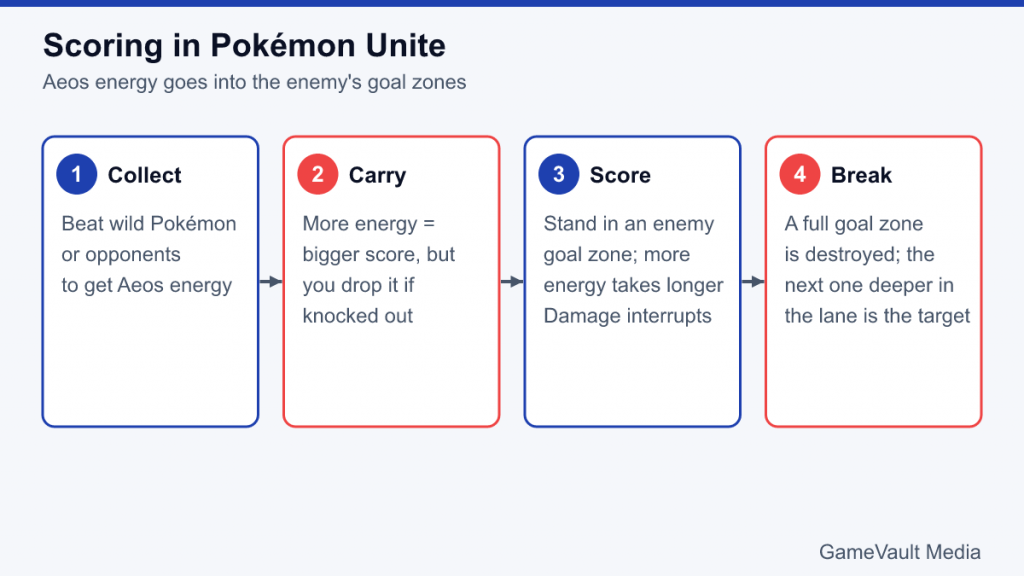
Several rules make scoring more than just running to the goal:
- Scoring takes time. You have to stand in the goal zone while the score is channeled, and carrying more energy takes longer to score. Taking damage or being hit by certain effects can interrupt you.
- Goal zones can be destroyed. Each goal zone can only absorb so many points. Once it is filled, it is destroyed, and the next goal zone deeper in that lane becomes the target.
- Your own goal zones help you. Standing in an allied goal zone restores your health over time, which makes them natural defensive positions and safe places to recover.
- Dying drops energy. If you are knocked out while carrying energy, you drop it, and opponents can pick it up. Carrying a lot is risky.
The result is a constant tension between collecting more energy for a big score and scoring early to avoid losing it. There is also no visible scoreboard during the match; announcements late in the game hint at which team is ahead, so you often play without knowing the exact score.
The Map, Wild Pokémon and Legendaries
The standard map has a top lane and a bottom lane with goal zones, plus a central area between them. Wild Pokémon live throughout the map; defeating them gives Aeos energy and experience, and some grant buffs.
At set times, more powerful wild Pokémon appear and become the main objectives, similar to dragons or Roshan in other MOBAs. The biggest of all is a Legendary Pokémon that arrives in the final stretch of the match. On the main map, Theia Sky Ruins, that Legendary is Rayquaza. Defeating it gives the winning team a large advantage at the moment when scoring matters most, which means Unite matches can swing dramatically in the last two minutes even if one team has been ahead all game.
The map and its objectives have changed over the game’s lifetime, so details such as spawn times and buff effects should be checked in the current version.
Leveling Up, Evolving and Learning Moves
Every Pokémon starts the match at level 1 and grows stronger by earning experience. Experience comes from defeating wild Pokémon, helping teammates defeat them, scoring goals and knocking out opponents.
As they level up, Pokémon:
- Learn new moves. At certain levels you choose between two upgrade options for a move slot. These choices shape your Pokémon’s playstyle for the rest of the match.
- Evolve. Pokémon that evolve in the main series often do so during a match. A Charmander, for example, evolves into Charmeleon and then Charizard as it reaches higher levels, gaining stats and new abilities.
- Unlock their Unite Move. Each Pokémon has a unique Unite Move, a powerful ability similar to an ultimate in other MOBAs, that becomes available at a certain level and charges up over time.
Because levels reset each match, early experience matters a lot. A Pokémon that falls behind in levels may miss a key evolution or move upgrade when a fight breaks out. Farming wild Pokémon efficiently, much like farming minions in other MOBAs, is one of the first skills to learn.
The Five Battle Types
Instead of lanes defining roles, Unite groups Pokémon into five battle types. The official site describes them like this:
| Battle type | Official description | Typical job | Examples |
|---|---|---|---|
| Attacker | Low endurance, strong ranged damage | Deal damage from a safe distance | Pikachu, Cinderace |
| Speedster | High mobility and offense | Pick off weak targets and score quickly | Zeraora, Gengar |
| All-Rounder | Balanced offense and endurance | Fight in close range and hold the line | Lucario, Machamp |
| Defender | High endurance; protects allies and hinders opponents | Absorb damage and stop enemy scoring | Snorlax, Slowbro |
| Supporter | Inflicts status conditions and heals allies | Keep teammates alive and disrupt enemies | Eldegoss, Wigglytuff |
A balanced team usually mixes durability, damage and support, much like the role systems in other MOBAs. Our guide to League of Legends roles shows how a more rigid role system compares.
Battle types are a starting point, not a strict rule. Some Pokémon can be built in different ways using moves and items.
Items: Held Items and Battle Items
Before a match, you set up items for your Pokémon. According to the official site, each Pokémon can hold up to three held items, chosen from more than 15 types, that give passive bonuses throughout the match. Trainers also bring one battle item, an active tool with a cooldown, such as a healing Potion, an X Attack that boosts damage briefly, or an Eject Button for quick repositioning.
Held items are upgraded outside of matches with in-game resources. Beginners should not worry too much about optimizing them; choosing items that match your battle type, such as damage items for Attackers and durability items for Defenders, is enough to start. The in-game recommended builds are a reasonable default.
Tips for New Players
- Complete the tutorials. They introduce scoring, moves and items step by step.
- Start with a forgiving Pokémon. Durable All-Rounders and Defenders let you learn the map without dying constantly.
- Score in small batches early. Holding large amounts of energy invites the enemy to knock you out and take it.
- Defend your goal zones. Stopping an enemy score can be worth as much as scoring yourself.
- Watch the timer. Plan to be ready, with your Unite Move charged, when the big objectives appear, especially in the final stretch.
- Stick with your team. Lone players are easy targets for groups.
- Use your Unite Move in fights. Saving it too long is a common mistake.
Common Questions
How long does a match of Pokémon Unite take?
A standard match lasts 10 minutes, plus the time spent selecting Pokémon. Quick Battle matches last about 5 minutes. A team can vote to surrender only after the halfway point, and only if a large majority agrees.
What happens if the score is tied?
According to Wikipedia’s description of the rules, a tie goes to the team that reached its final score first. That is one more reason scoring steadily through the match is better than waiting for one huge goal at the end.
Do I need to pay to be competitive?
The game is free to start. Pokémon, held items and their upgrades can all be earned through regular play and in-game rewards, and the most important skills, such as positioning, timing and teamwork, do not depend on spending. Cosmetic outfits do not affect gameplay.
Do Pokémon types like Fire or Water matter?
No. The main series’ type matchups do not apply in Unite. What matters is a Pokémon’s battle type, moves and items, not whether it is a Fire or Water type.
How Unite Differs From Other MOBAs
- No base to destroy. Points decide the winner, not structures.
- Fixed match length. Standard matches last 10 minutes, far shorter than a typical League or Dota game.
- No item shop during the match. Items are chosen beforehand, so there is no mid-match gold economy in the traditional sense.
- Evolution as progression. Instead of only stat growth, Pokémon visibly transform as they level.
- Simple controls. Designed for a controller or touchscreen, with fewer buttons than PC MOBAs.
These differences make Unite a friendly entry point to the genre. Habits like farming efficiently, fighting together and controlling objectives carry over to other MOBAs, while its scoring system gives it an identity all its own.