The Dota 2 Map Explained: Lanes, Towers, Barracks, Outposts and Lotus Pools
A tour of the Dota 2 map as of 2026: Radiant and Dire, tower tiers, barracks and mega creeps, high ground, outposts, Tormentors, shrines and Lotus Pools.
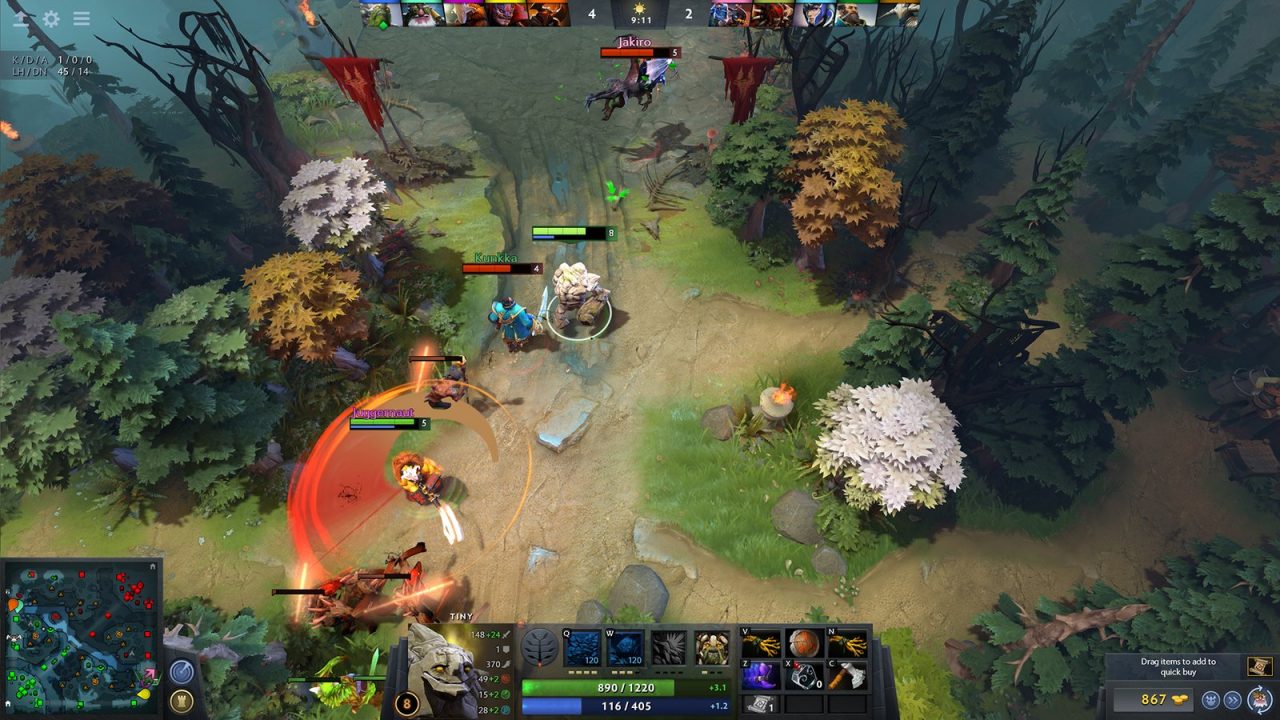
The Dota 2 map looks overwhelming the first time you open it. Two bases sit in opposite corners, three lanes run between them, and the space in between is packed with trees, camps, cliffs, rivers and a growing list of special objectives. The good news is that the core structure has barely changed in two decades. Everything Valve has added in recent years is layered on top of a design that goes back to the original Defense of the Ancients map.
This guide walks through that structure first, then explains the newer features that matter in every match: outposts, Tormentors, Twin Gates, Watchers, shrines and Lotus Pools. Dota’s map is reworked often, sometimes dramatically, so specific details are dated. Everything here reflects the game as of patch 7.41, which was released on March 25, 2026, and the smaller updates that followed it.
Radiant, Dire and the Three Lanes
Every match is Radiant versus Dire. The Radiant base sits in the bottom-left (southwest) corner and the Dire base in the top-right (northeast). A river runs diagonally between them, splitting the map into two halves, and each half contains a jungle full of neutral creep camps.
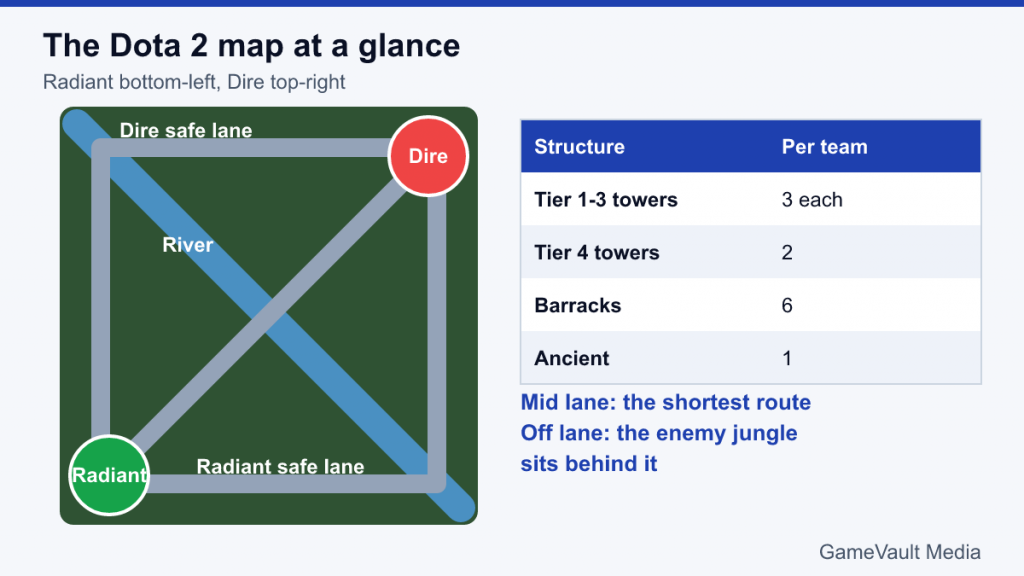
Three lanes connect the bases:
- The safe lane is the bottom lane for Radiant and the top lane for Dire. It is called “safe” because your own jungle sits behind it, so your carry can farm with an easy escape route.
- The middle lane runs straight down the diagonal and is the shortest route between bases.
- The off lane is the opposite of each team’s safe lane. The enemy’s jungle is behind it, which makes it more dangerous to play.
Lane creeps spawn in waves from each base and march down all three lanes, meeting somewhere in the middle. Patch 7.41 adjusted early wave timings so the first creep clashes happen closer to the off lane’s tower, which gives off laners a little more safety in the opening minutes. If you want to know which heroes usually play where, our guide to Dota 2 positions 1–5 explains the role system.
Towers, Barracks and the Ancient
Each team’s structures follow the same layout, and destroying them in order is how a game is won.
| Structure | Number per team | Role |
|---|---|---|
| Tier 1 towers | 3 (one per lane) | The outermost defenses; usually the first to fall |
| Tier 2 towers | 3 | Mid-map defenses, often the target of mid-game pushes |
| Tier 3 towers | 3 | Guard the barracks on the high ground |
| Tier 4 towers | 2 | Stand next to the Ancient as its final guards |
| Barracks | 6 (melee and ranged in each lane) | Destroying them strengthens your creeps in that lane |
| Ancient | 1 | Destroy the enemy’s Ancient to win |
Tower order and protection
Towers in a lane must be destroyed in order: a tier 2 tower cannot be damaged while the tier 1 tower in front of it is still standing. Each team also has a Glyph of Fortification, a shared ability that makes all of its buildings temporarily invulnerable and is used to buy time against a push. Buildings have backdoor protection too, which reduces damage and regenerates health when they are attacked without enemy creeps nearby, discouraging sneaky solo pushes.
Barracks and mega creeps
Each lane has a melee barracks and a ranged barracks on the high ground. Destroying one makes your matching creeps in that lane stronger, turning them into super creeps. If a team loses all six barracks, the other team’s creeps in every lane become mega creeps, powerful enough to push into the base on their own. Games with mega creeps are hard, though not impossible, to come back from.
Defender’s Gate
Patch 7.40 (December 2025) added a Defender’s Gate to both bases, a backdoor-style exit on the far side of each base that also provides a small amount of vision. It gives defenders another route out of their base when the main lanes are under siege.
The High Ground
Both bases sit on raised terrain known as the high ground. Units on lower ground cannot see up a cliff without vision from a ward, a flying unit or an ally already up there, while defenders on the high ground can see attackers coming up the ramps. This makes pushing into a base, called “taking high ground,” one of the hardest moments in any match. Attacking teams usually wait for a numbers advantage, a strong item timing or the Aegis from Roshan before committing.
Teams that fail at high ground often lose more than they gained in the fights leading up to it, which is why patience matters even when you are ahead.
Neutral Camps, Roshan and the Tormentor
Neutral creep camps
Each jungle contains camps of neutral creeps in small, medium, large and ancient sizes. They respawn at regular intervals and provide gold and experience to anyone who clears them, which is why supports pull and stack them and carries farm them between waves. Patch 7.38 (“Wandering Waters,” February 2025) added streams of water through both jungles, with flooded camps holding amphibious creeps, and 7.40 demoted some camps and narrowed paths through the outer jungles.
Roshan
Roshan is the map’s most important neutral objective, dropping the Aegis of the Immortal and other rewards. Since 7.38 his two pits sit in the river near the Power Rune spots, and he alternates between them with the day and night cycle. Patch 7.41 swapped which side he and the Tormentor start on. Our full Roshan guide explains his rewards and how teams contest him.
Tormentor
The Tormentor is a stationary mini-boss introduced in patch 7.33 (April 2023). It does not attack on its own; instead it reflects damage back at the heroes hitting it and protects itself with a regenerating barrier, so it rewards teams that commit several heroes at once. Killing it grants an Aghanim’s Shard to the team that took it. Since 7.38 it appears at 15:00 in one of the map’s far corners, opposite Roshan’s current side. In 7.41 it was made tankier but with less early barrier regeneration and less damage reflection, and its spawn point was moved closer to the Lotus Pools.
Outposts, Twin Gates and Watchers
Outposts
Outposts are capturable structures on the map. Holding one lets your heroes teleport to it with a Town Portal scroll, which turns it into a forward base for rotations, ganks and defending nearby objectives. When outposts were first added they also granted experience and vision, but patch 7.33 removed both of those rewards and added two more outposts, so today they are valued mainly for mobility and the map control that comes with it.
Twin Gates
Added in 7.33, the Twin Gates are a linked pair of portals on opposite edges of the map. A hero can channel at one gate to travel to the other, which allows quick rotations from one side of the map to the other. The channel can be interrupted, and enemies who see you use a gate know where you are heading. Patch 7.41 shifted the gates back toward the map’s edges.
Watchers
Watchers are small structures scattered around the map that provide vision of their area when activated by a hero. They make it easier to scout without spending wards, but they also show the enemy roughly where you have been. Several Watchers were moved in 7.40.
Shrines, Lotus Pools and Runes
Shrines of Wisdom
Wisdom Runes were added in 7.33 as an experience boost that spawned near the edges of the map. In 7.38 they were converted into Shrines of Wisdom. Instead of simply grabbing a rune, a team must stand inside the shrine area to activate it, and the presence of a nearby enemy unit blocks activation. The result is that experience is gained by controlling an area rather than by racing to a pickup. In 7.40 the shrine areas were lowered into sunken terrain, which makes them more dangerous to contest because attackers above can see in while defenders below cannot see out.
Lotus Pools
Lotus Pools also arrived in 7.33. They grow Healing Lotuses that heroes can collect and consume to restore health and mana. Since 7.38 they work like the shrines, activating when a team holds the area without enemies nearby, and they offer higher-grade lotuses later in the game. As of 7.41 they sit closer to the off lane’s tower.
Power and Bounty Runes
Runes appear at fixed spots in the river and near the jungles at regular intervals. Power runes grant temporary buffs such as double damage, haste or invisibility, and Bounty runes grant gold. Mid laners in particular plan their movements around rune timings, which we cover in a separate guide.
Shops and the Fountain
Each base has a main shop and a fountain, which rapidly restores health and mana and is heavily defended. Items not sold in the main shop are found in the Secret Shop. Couriers deliver purchases to heroes in the field, so most players buy items remotely rather than walking to a shop.
How Patch 7.33 Reshaped the Map
The single biggest map change in Dota’s recent history came with patch 7.33, “New Frontiers,” in April 2023. It expanded all four edges of the map, added a dozen new neutral camps, the Tormentors, Twin Gates, eight Watchers, Lotus Pools and Wisdom Runes, moved Roshan to the corners with a day/night side swap, and removed outpost experience and vision. The larger map gave more room for rotations and jungling and made map movement a much bigger part of the game.
Later patches refined rather than reversed that direction. 7.38 brought Roshan back to the river, reduced the Tormentors to a single active one at a time and reworked objectives into shrines, 7.40 tightened jungle paths and added the Defender’s Gate, and 7.41 adjusted objective sides and creep waves. The lesson for players is that the fundamentals stay the same while the details move, so after a big patch it is worth spending a few minutes in a lobby simply walking around the new map.
Tips for Learning the Map
- Watch the minimap constantly. Missing enemy heroes on the minimap usually means danger nearby.
- Learn your safe lane and off lane. They are mirrored between Radiant and Dire, which confuses many beginners.
- Use outposts and Twin Gates. They save time that would otherwise be spent walking.
- Do not take high ground without an advantage. Defenders have vision, buildings and the fountain on their side.
- Explore in a private lobby. Walking the map without pressure is the fastest way to learn its routes.
For a wider learning plan, see our Dota 2 beginner’s guide.