From DotA Allstars to Dota 2: The History of Dota
How a Warcraft III custom map became Dota 2: Eul's original DotA, Guinsoo's Allstars, IceFrog's long stewardship, the Valve trademark fight and Source 2.
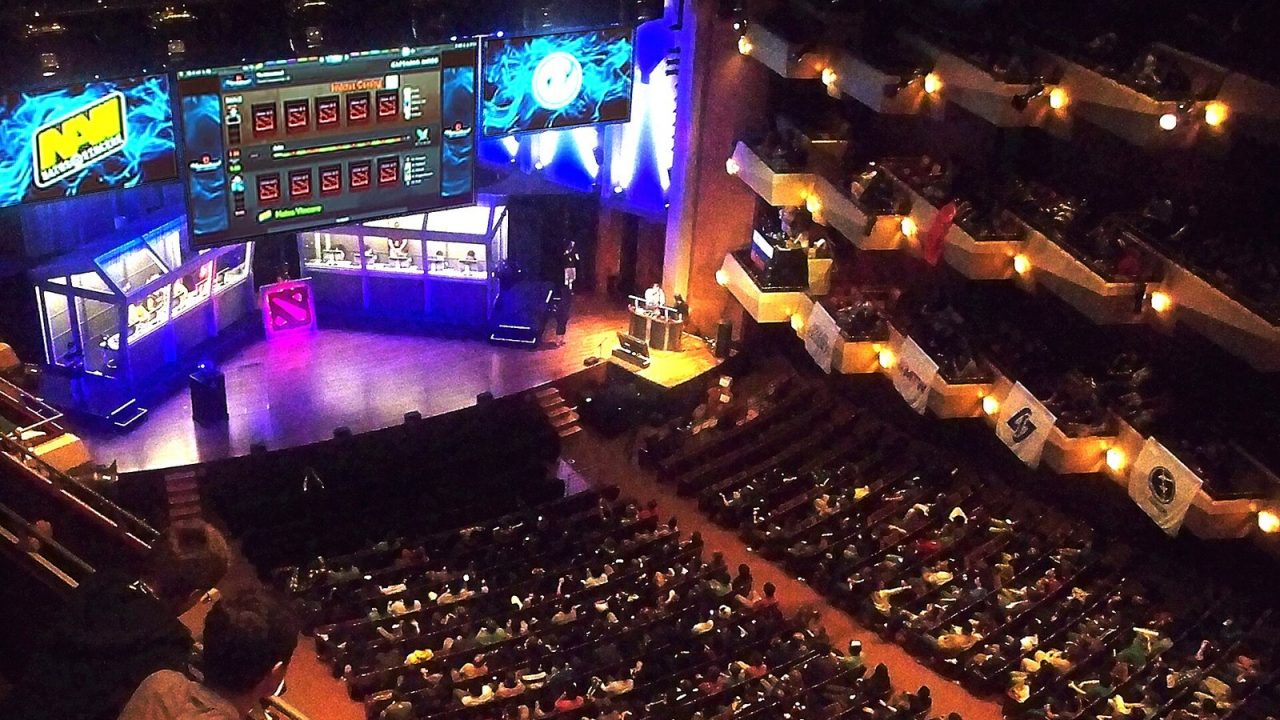
Few major games began as humbly as Dota. Its roots lie in a custom map made by a hobbyist with a free level editor, refined over years by a handful of anonymous or pseudonymous designers, and played in LAN cafés and online lobbies long before any company owned it. By the time Valve released Dota 2 in 2013, the game had already been evolving for a decade.
This article traces that journey: from the StarCraft map that inspired it, through Eul’s original Defense of the Ancients and the Allstars era, to IceFrog’s move to Valve, the legal fight over the name “Dota” and the Source 2 relaunch. The focus is on the game and its design rather than the competitive scene. For the broader genre story, including League of Legends and newer games, see our history of the MOBA genre.
Before Dota: Aeon of Strife
The idea that became Dota first appeared in Aeon of Strife, a custom map for Blizzard’s StarCraft. Instead of commanding an army, each player controlled a single powerful hero and fought alongside computer-controlled units against waves of enemies across several lanes. It was a simple scenario, but the core idea of one player, one hero, and lanes of automatic units was already there.
StarCraft’s editor had limits, and the concept really took off when Blizzard released Warcraft III: Reign of Chaos in 2002. Warcraft III was built around hero units that leveled up and carried items, and its World Editor was powerful enough that modders could build almost entirely new games inside it.
Eul’s Defense of the Ancients (2003)
In 2003 a modder known as Eul created the first version of Defense of the Ancients in the Reign of Chaos World Editor, drawing on the Aeon of Strife formula. Two teams defended their own base structure, the Ancient, while heroes and waves of units pushed down three lanes toward the enemy. The goal, destroying the opposing Ancient, still defines Dota today.
When Blizzard released the expansion The Frozen Throne, the World Editor gained new features. Eul did not keep updating his scenario for the expansion. Instead he released the map’s code as open source, which allowed other creators to build their own versions. Many variants appeared, each with different heroes and rules, and the scene briefly fragmented. Eul’s name survives in the game today: Eul’s Scepter of Divinity is one of Dota 2’s best-known items.
Guinsoo and DotA Allstars
Among the variants, one became dominant: DotA Allstars. It was first assembled by modders named Meian and Ragn0r, who gathered the most popular heroes from various versions into a single map. In March 2004, development was taken over by Steve “Guinsoo” Feak, who shaped Allstars into something closer to the modern game.
Two of Guinsoo’s additions are still central to Dota:
- Item recipes. Guinsoo introduced a system in which basic items combine into stronger ones, which became the foundation of MOBA itemization. Our guide to Dota 2 items explains how that system works now.
- Roshan. He added a powerful neutral boss that required a full team to defeat. Roshan remains the most important neutral objective in Dota 2 more than two decades later.
Allstars grew rapidly through community sites and tournaments at LAN events. The site dota-allstars.com, run by Steve “Pendragon” Mescon, became the game’s main hub for discussions, guides and map downloads.
IceFrog Takes Over
Around 2005, development passed briefly to a designer called Neichus and then to IceFrog, a developer who has kept his real identity largely private ever since. IceFrog maintained the map for years, adding new heroes, mechanics and balance changes at a steady pace and fixing countless bugs. Under his stewardship Allstars grew to include more than a hundred heroes, an enormous number for a custom map running inside another game’s engine.
IceFrog’s approach became a signature of Dota. Rather than simplifying the game for newcomers, he kept its depth and quirks, such as denying allied creeps, turn rates and complex item interactions, while constantly adjusting balance so that many heroes and strategies stayed viable. Patches were released with detailed change lists that the community studied closely, a tradition that continues with Dota 2 patch notes today.
A community split
The game’s popularity also brought changes to its community. Guinsoo and Pendragon later moved on to the company that became Riot Games, where Feak worked on League of Legends, applying lessons from DotA to a new standalone game. After Riot acquired the dota-allstars.com domain, the community divided, and IceFrog announced a new official site, playdota.com, as the home for his version of the map.
Valve Hires IceFrog (2009)
In October 2009, IceFrog revealed that he had joined Valve to lead development of a new Dota game. The project was announced publicly in 2010 as Dota 2. Valve’s goal was to recreate the Allstars experience in its own Source engine while adding modern features: proper matchmaking, a coaching and spectator system, a tutorial and support for the community through tools and cosmetic items.
Closed beta invitations began going out around Gamescom in August 2011, and the game was shown publicly with a large-scale tournament later that month. The beta expanded through 2011 and 2012, and in April 2012 Valve confirmed that Dota 2 would be free-to-play, with every hero available to every player at no cost. Revenue would come from cosmetic items rather than from selling heroes, a decision that set Dota 2 apart from many competitors of the time.
The Battle Over the Name “Dota”
Shortly after announcing Dota 2 in 2010, Valve filed a trademark application for the term “Dota.” That raised objections. Many in the community felt the name belonged to the mod scene, and Blizzard, whose Warcraft III engine and editor had made DotA possible, formally opposed the application in November 2011.
The dispute was settled on May 11, 2012. Under the agreement, Valve retained the right to use “Dota” commercially, including for Dota 2, while non-commercial use, such as fan-made maps, remained open to players. As part of the deal, Blizzard renamed the MOBA it was developing at the time, which had been shown as “Blizzard DOTA,” to Blizzard All-Stars. That project was renamed again to Heroes of the Storm in October 2013 and released in June 2015.
The trademark question did not completely go away. In 2017, a lawsuit involving other companies’ use of Dota characters challenged Valve’s ownership, and a US judge declined to dismiss the case outright. For players, however, the main outcome of the 2012 settlement was clear: Dota 2 kept its name.
Dota 2’s Release and Reborn
Dota 2 officially launched on Windows on July 9, 2013, followed by OS X and Linux versions on July 18, 2013. It arrived with a large part of the Allstars roster already ported, and Valve continued adding the remaining heroes over the following years before introducing entirely new heroes designed for Dota 2.
In June 2015, Valve announced Dota 2 Reborn, an update that moved the game to Valve’s new Source 2 engine. It began as an opt-in beta and replaced the original client in September 2015, making Dota 2 the first game released on Source 2. Reborn brought a new interface and, importantly, a new custom game system that let modders build their own games inside Dota 2, mirroring how Dota itself had started inside Warcraft III.
Custom games come full circle
That custom game system went on to produce one of the biggest surprises in the genre’s history. In early 2019 a custom game called Dota Auto Chess exploded in popularity and launched a new genre, the auto battler. We cover that story in a separate article, but it is a fitting echo: a mod inside a game born from a mod.
Major Updates Since Release
Dota 2 is known for large, game-changing patches rather than small seasonal tweaks. A few stand out:
| Update | When | What changed |
|---|---|---|
| 7.00 “The New Journey” | December 2016 | Introduced hero talent trees, a new heads-up display and major map changes |
| 7.33 “New Frontiers” | April 2023 | Expanded the map on all four sides, added new objectives and introduced the Universal attribute |
| 7.38 “Wandering Waters” | February 2025 | Added jungle streams, moved Roshan back to the river and turned Wisdom Runes and Lotus Pools into shrines |
| 7.41 | March 2026 | Removed hero facets, overhauled innate abilities and adjusted objectives |
Over the same period Valve experimented with spin-offs built on the Dota universe. Artifact, a digital card game, launched in November 2018, and Dota Underlords, an auto battler, was fully released in February 2020. For a walkthrough of how today’s map looks after these patches, see our guide to the Dota 2 map.
What Has Stayed the Same
For all the changes, a player from the Allstars era would still recognize Dota 2 instantly. Two teams of five still fight across three lanes to destroy the enemy Ancient. Heroes still farm creeps, deny allied units and build items from recipes. Roshan still waits in the river. Many of the original heroes, from Pudge to Crystal Maiden, keep their core abilities.
That continuity is part of Dota’s identity. The game has always been willing to overhaul its systems, but it has done so on top of a foundation that a volunteer community built inside someone else’s game more than twenty years ago.
Key Dates at a Glance
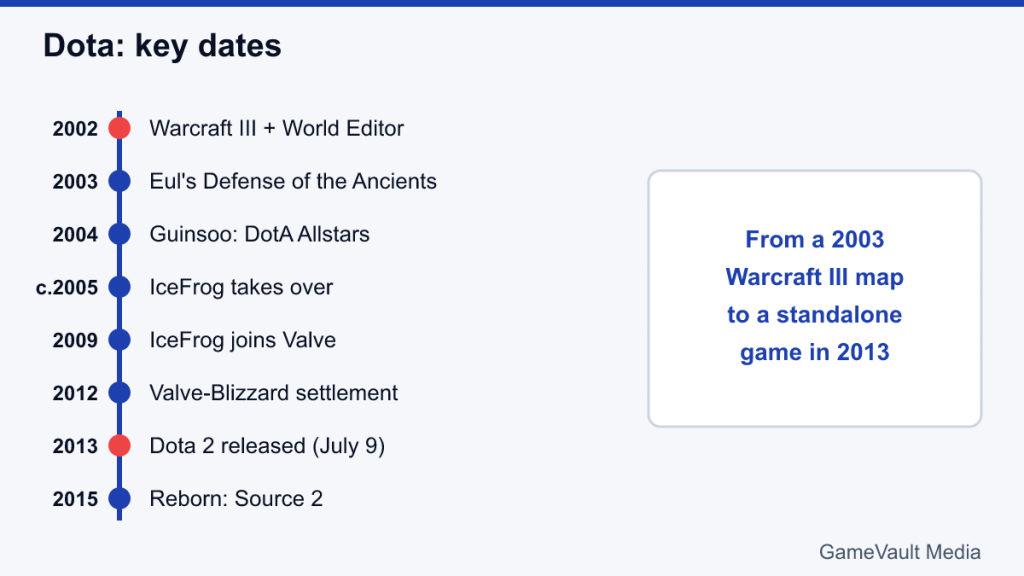
- 2002: Warcraft III: Reign of Chaos released with its World Editor.
- 2003: Eul creates Defense of the Ancients.
- March 2004: Guinsoo takes over DotA Allstars.
- Around 2005: IceFrog becomes lead developer after Neichus.
- October 2009: IceFrog announces he has joined Valve.
- 2010: Dota 2 announced; Valve files the “Dota” trademark.
- May 2012: Valve and Blizzard settle the trademark dispute.
- July 9, 2013: Dota 2 released on Windows.
- September 2015: Dota 2 Reborn moves the game to Source 2.