TFT Economy Explained: Interest, Streaks, Leveling and Rolling
How gold works in Teamfight Tactics: passive income, interest up to 50 gold, win and loss streaks, buying XP versus rolling, and the main economy plans.

Every round of Teamfight Tactics ends with the same quiet decision: what do you do with your gold? You can spend it on experience to raise your level, spend it on rerolling the shop to find the units you need, or save it so that it earns more gold next round.
This guide explains where TFT gold comes from, why holding 50 gold matters so much, how win and loss streaks pay out, and how leveling and rolling compete for the same coins. It also covers the classic economy plans you will hear players talk about, such as fast leveling and slow rolling. If you are completely new to the game, start with our beginner’s guide to how Teamfight Tactics works, then come back here. Numbers below reflect the official League of Legends wiki’s TFT pages as of October 2026; Riot occasionally tweaks economy values between sets, so always check the patch notes if something feels off.
Where Your Gold Comes From
TFT gold comes from a handful of sources, and they add up at the start of each planning phase. Understanding which ones you control is the first step toward a healthy economy.
Passive income
Every player receives a fixed amount of gold at the start of each round. During the opening rounds it is reduced while the game gets going, and from stage 2 onward the standard passive income is 5 gold per round. You cannot change this number with play, but it is the backbone of everything else: five gold a round is enough to buy a couple of units or one purchase of experience, and not much more.
Interest
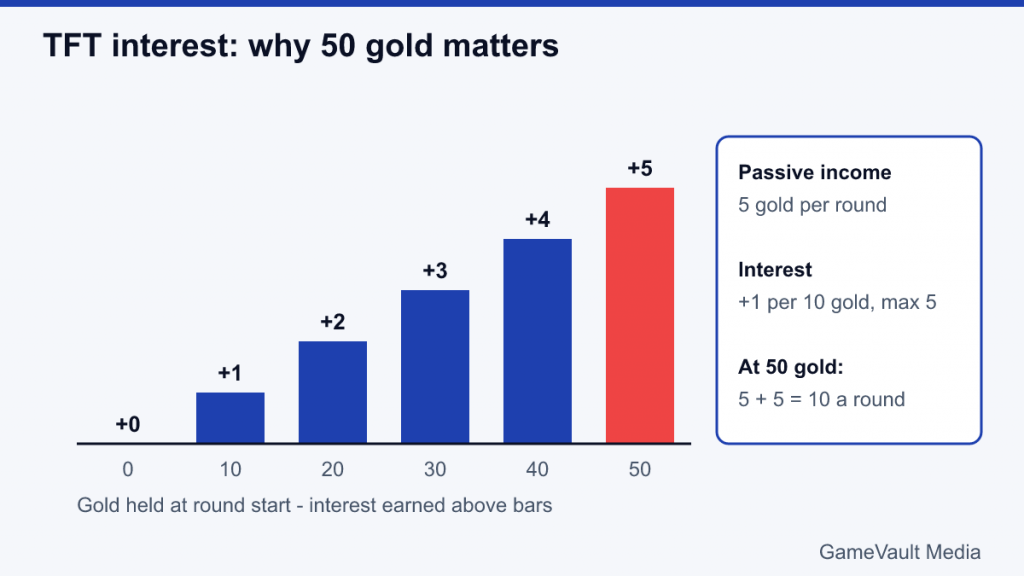
Interest is the most important income source you control. At the start of each round you receive 1 extra gold for every 10 gold you are holding, up to a maximum of 5 gold. That cap is reached at 50 gold. Interest is calculated before passive income is added, so the number that matters is how much you had banked at the end of your previous turn.
Interest is calculated in whole steps, which creates the famous “breakpoints” of 10, 20, 30, 40 and 50 gold. Holding 29 gold pays the same interest as holding 20. That is why experienced players often spend down to exactly a multiple of ten: any coin above a breakpoint earns nothing extra unless it pushes you over the next one.
Some augments change the interest rules, for example by raising the cap or by giving up interest in exchange for another effect. Treat the normal 50-gold cap as the default and read an augment’s text carefully when it mentions interest.
Streak gold
Winning or losing several player-versus-player rounds in a row pays bonus gold. According to the official wiki’s income table, a streak of 3–4 rounds pays +1 gold, a streak of 5 pays +2, and a streak of 6 or more pays +3 per round. Win streaks and loss streaks use the same values. Riot has changed these breakpoints several times over the game’s history, so the exact numbers are worth checking each set, but the principle has stayed the same: consistency is rewarded in either direction.
Winning rounds and other sources
Winning a PvP round grants an extra 1 gold. On top of that, PvE rounds against monsters drop loot orbs that can contain gold, units or items, and many augments and traits produce gold of their own. These sources vary from game to game, so a good economy plan is built on passive income, interest and streaks, with everything else treated as a bonus.
Why 50 Gold Is the Magic Number
Because interest caps at 5 gold, a player sitting on 50 gold earns roughly double what a player with no savings earns from passive income alone. Over several rounds that difference compounds into multiple extra levels or dozens of extra shop rolls later in the game.
A simple illustration using the rules above: a player who holds 50 gold at the end of every round from early stage 3 onward receives 5 passive plus 5 interest, or 10 gold per round, before any streak bonus. A player who spends to zero every round receives 5. Across ten rounds, that is a 50-gold difference, which is enough to buy more than ten purchases of experience or 25 rerolls.
This is why the phrase “getting to 50” is so common in TFT advice. The goal of the early game, for most plans, is to reach 50 gold quickly and then spend only the gold above 50 each round, so interest never drops. Once you are at 50, extra gold beyond it is free to spend.
Buying XP: How Leveling Works
Your level controls two things: how many units you can field on the board, and the odds of seeing higher-cost champions in your shop. Each level adds one unit slot, and higher levels shift the shop toward more expensive and usually more powerful units.
You gain experience in two ways:
- Passive XP: 2 XP automatically at the end of each round.
- Buying XP: pressing the Buy XP button costs 4 gold for 4 XP.
Experience requirements grow as you climb. Early levels need only a handful of points, while the jumps to levels 8 and 9 each take dozens of XP, which is to say many purchases of 4 gold. The game shows you exactly how much is left to the next level on the Buy XP button, so you can plan purchases rather than guess.
Why level timing matters
Leveling gives you an extra unit on the board immediately, which is a direct boost to combat strength. It also improves your future shops. The catch is that every 4 gold spent on experience is 4 gold that is not earning interest or buying units. Players therefore try to level at specific, efficient moments, typically at the start of a stage or right before a round where an extra unit would decide a fight. Standard level timings shift with each set’s balance, so understanding the trade-off matters more than memorizing a script.
Rolling the Shop
Each round you see a shop of five champions. Pressing the refresh button, called rolling or rerolling, costs 2 gold and shows a new set of five. Rolling is how you find the specific copies you need to upgrade champions to 2 and 3 stars, since three copies of the same unit combine into a 2-star and three 2-stars combine into a 3-star.
Champion copies come from a shared pool. If several players are buying the same unit, there are fewer copies left for everyone. This is why scouting matters to your economy: rolling for a unit that three other players are also collecting is far more expensive than rolling for one nobody else wants.
Rolling has no lasting value on its own. Gold spent on experience at least moves you toward the next level permanently; gold spent on a roll that finds nothing is simply gone. That is why disciplined players roll in planned bursts rather than one or two clicks every round.
The Main Economy Plans
Players describe their economy approach with a few common labels. None of them is “correct” in every game. The right one depends on your opening units, your augments, which units are contested and how much health you have left.
| Plan | Basic idea | Best when |
|---|---|---|
| Fast leveling (“fast 8” and similar) | Save to 50, buy XP above it, reach high levels quickly, then roll for high-cost carries | Your board is stable and your win condition uses 4- or 5-cost units |
| Slow rolling (“slow roll” or reroll) | Stay at a lower level, hold 50 gold, and roll only with the gold above 50 each round | Your carry is a low-cost unit you want at 3 stars |
| All-in roll | Spend most or all gold at a single moment to stabilize | You are losing health quickly and need a stronger board now |
| Loss streaking | Deliberately field a weak board early to collect loss-streak gold and good carousel priority | Your opening shops are poor and you can afford some health loss |
| Win streaking | Spend to keep the strongest board and collect win-streak gold | You have a strong opening and can keep winning |
Fast leveling
The fast-level plan treats experience as the main investment. By reaching higher levels earlier, you see more high-cost units and field more of them. It works best with compositions whose main carries are 4- or 5-cost champions, which appear rarely at low levels. The risk is that you spend on levels while your board stays weak, so you lose health while building toward a strong late game.
Slow rolling
Slow rolling flips the priority. You settle at a level where your target low-cost units appear often, keep 50 gold banked, and roll only with your surplus each round. Because your interest stays maxed, you keep earning while you search, and you can usually 3-star a cheap carry over several rounds. The risk is that if those units are contested by other players, your rolls dry up and you are stuck at a low level while others pull ahead.
Streaking
Both win and loss streaks pay gold, which leads to deliberate streaking strategies. A win streak uses early strength to bank streak gold while protecting health. A loss streak accepts early damage in exchange for streak gold and, in many sets, earlier picks in shared selection rounds. Loss streaking is risky because health in TFT does not come back, and it only pays off if you convert the extra gold into a strong board before your health gets too low.
Common Economy Mistakes
- Breaking a streak by accident. Winning one round in the middle of a loss streak, or dropping one in a win streak, resets the bonus. If you are streaking, make the decision consciously.
- Sitting just above a breakpoint. Holding 38 gold earns the same interest as holding 30. If you need to spend, spend the gold above the last ten.
- Rolling a little every round. Small, unplanned rolls drain interest without reliably finding upgrades. Roll in focused bursts with a clear target.
- Greeding too long. Gold is only useful if you spend it before you are eliminated. Players sometimes protect their 50 gold while losing large chunks of health, then roll when it is too late.
- Ignoring what others are building. Use the scoreboard to check opponents’ boards. If your carry is contested, your economy plan should change.
- Selling units carelessly. Selling returns gold, but upgraded units and higher-cost units sell back with a small penalty, so constantly buying and selling loses value over a game.
Items and augments interact with all of this. A strong set of completed items on one carry can let you save longer, while a lack of items might push you to level for raw board strength instead. Our guide to TFT items and choosing item holders covers that side of planning.
Frequently Asked Questions
What is the maximum interest in TFT?
Under the standard rules, interest is 1 gold per 10 gold held, capped at 5 gold per round once you hold 50 gold. Some augments change this.
How much does it cost to buy XP and reroll?
Buying XP costs 4 gold for 4 experience, and a shop reroll costs 2 gold. You also gain 2 XP for free every round.