What Is an Auto Battler? How the Genre Works
What an auto battler is, how drafting, positioning, economy and synergies work, and how TFT, Dota Underlords, Auto Chess and others compare.
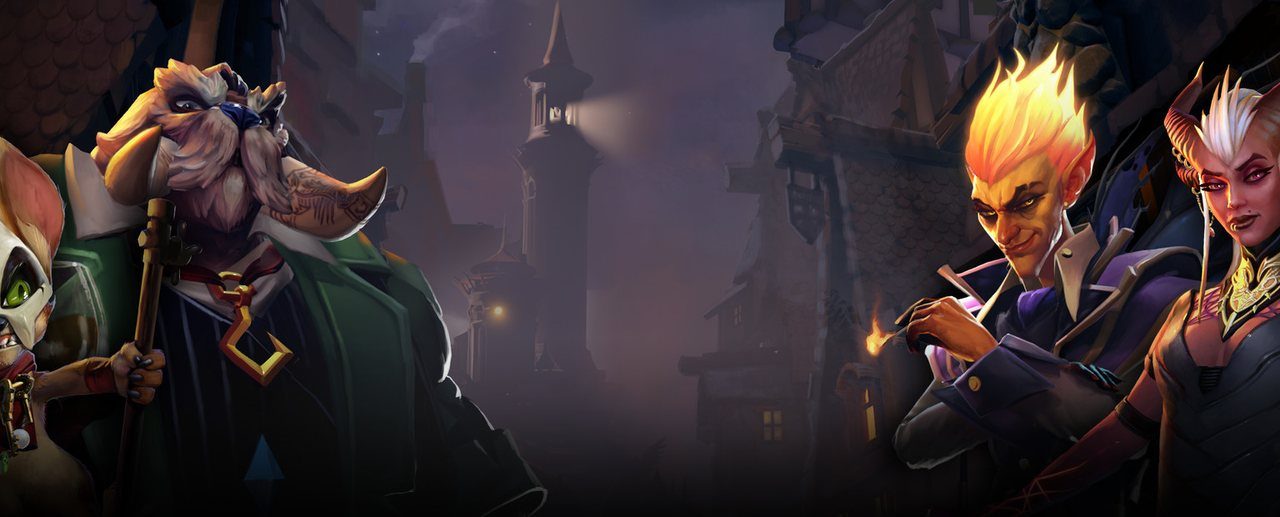
An auto battler, also called auto chess, is a strategy game in which you build a team of units and place them on a board, and then the units fight on their own. You never control them in combat. All your decisions happen between fights: which units to buy, which to combine, where to place them and how to manage your gold. Typically eight players compete in the same match, facing each other in rotating one-on-one battles until only one remains.
The genre exploded in 2019 out of a Dota 2 custom game, and its best-known example today is Riot’s Teamfight Tactics. This guide explains the core mechanics that nearly all auto battlers share, compares the major games and explains why the genre is more strategic than it looks.
Where the Genre Came From
Like the MOBA, the auto battler grew from player-made custom games. Warcraft III maps such as Legion TD, created around 2008 by a player known as Lisk, already had players building armies that fought automatically. The modern form, however, comes from Dota Auto Chess, a custom game mode for Dota 2 released in January 2019 by the Chinese team Drodo Studio. It used Dota heroes as chess-like pieces, and it spread at remarkable speed, reaching more than eight million players by May 2019.
Within months, the big studios responded. Valve developed its own version, Dota Underlords, Riot launched Teamfight Tactics inside League of Legends, and Drodo Studio released a standalone game called Auto Chess. In November 2019, Blizzard added Battlegrounds to Hearthstone. For more on how the MOBA roots fit into the picture, see our history of the MOBA genre.
The Core Loop of an Auto Battler
Almost every auto battler is built from the same five ingredients.
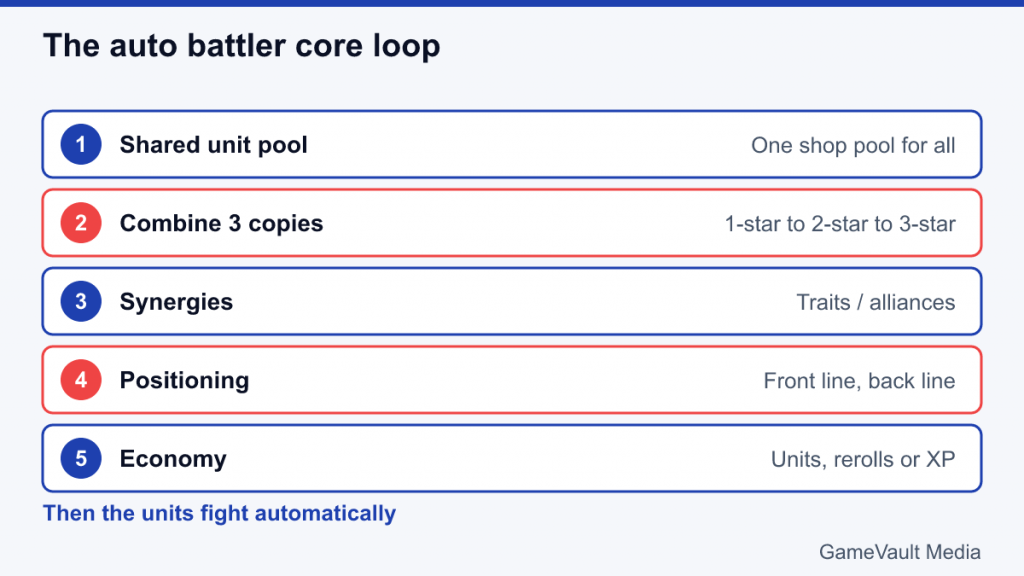
1. A shared pool of units
Units are bought from a shop that refreshes each round. Crucially, all players draw from a shared pool. If several players want the same unit, they compete for a limited number of copies. This turns the game into a hidden drafting contest: what you buy affects what other players can find.
2. Combining units
Buying three copies of the same unit usually merges them into a stronger version, often shown as a 2-star unit. Three 2-star units combine again into a 3-star unit. Upgrading is one of the main ways to grow stronger, and deciding which units to chase is a key part of strategy.
3. Synergies
Every unit belongs to one or more groups, called traits in TFT, alliances in Underlords, or tribes in other games. Fielding several units from the same group activates bonuses, which grow stronger at higher thresholds. Building around synergies is what gives each team its identity.
4. Positioning
Before each fight, you arrange units on a grid. Durable units go in front to absorb damage, fragile damage dealers stay in the back, and you can shift your setup to counter specific opponents. Because combat is automatic, positioning is one of your few direct ways to influence the fight.
5. Economy
Gold arrives every round. You can spend it on units, on refreshing the shop, or on experience to raise your level, which lets you field more units and find rarer ones. Many auto battlers also reward you for saving gold through interest, and for winning or losing several rounds in a row. Balancing spending now against saving for later is a constant tension.
How a Match Unfolds
Matches follow a recognizable arc. The early rounds are quick, with weak units and small damage, and many games include rounds against computer-controlled monsters that drop items. In the middle of the game, players commit to a direction based on the units and items they have found, level up and build toward strong synergies. In the late game, health totals are low, damage from losses is high, and each fight can eliminate someone.
Placement matters more than winning outright. In TFT ranked play, finishing in the top four of eight is generally considered a good result. This changes how players think: a safe fourth place can be worth more than a risky attempt at first.
The Main Auto Battlers Compared
| Game | Developer | Released | Notable features |
|---|---|---|---|
| Dota Auto Chess | Drodo Studio | January 2019 (Dota 2 custom game) | The original modern auto battler, using Dota heroes |
| Teamfight Tactics | Riot Games | June 2019 (mobile from March 2020) | League champions, item combining, sets that rotate several times a year |
| Dota Underlords | Valve | Early access June 2019; full release February 2020 | Alliances, choosable Lords that act as board leaders, PC and mobile cross-play |
| Auto Chess | Drodo Studio | 2019 (standalone) | Standalone version of the original mod with its own pieces |
| Hearthstone Battlegrounds | Blizzard Entertainment | November 2019 | Minions from Hearthstone, heroes with unique powers |
Teamfight Tactics
TFT is the most-played auto battler and the most actively updated. Its distinctive features include combining item components on units, a shared draft round called the carousel in most sets, augments that change your strategy mid-game, and complete roster changes with each new set. Our TFT beginner’s guide walks through a full game.
Dota Underlords
Valve’s version uses Dota heroes on an 8×8 board. After the early rounds, players choose a Lord, a special unit that fights on the board and adds powers. It supported full cross-play between PC and mobile and reached full release in February 2020.
Hearthstone Battlegrounds
Blizzard’s take uses minions from its card game. Each player picks a hero with a unique power, and the game’s minion types act as synergies. It plays faster than TFT and fits players who already know Hearthstone.
Other examples
Indie developers have pushed the genre in new directions. Super Auto Pets uses cute animals and asynchronous matches, while games such as Storybook Brawl and Backpack Battles borrow the format with their own twists. In July 2025, Clash Royale added Merge Tactics as a permanent mode, showing how the idea keeps spreading.
Strategy or Luck?
Newcomers sometimes dismiss auto battlers as random, because the shop offers random units and fights play out automatically. Randomness is real, but strong players consistently place higher than weak ones, for several reasons:
- Probability management. Shop odds depend on your level. Knowing when to level up and when to refresh the shop is a skill.
- Flexibility. Good players adapt to the units and items they are offered instead of forcing one plan.
- Reading the lobby. Watching what others are building tells you which units will be scarce and which compositions are open.
- Economy. Saving gold for interest and spending at the right moments creates large differences in power over a game.
- Positioning. The same units can win or lose a fight depending on their arrangement.
In that sense, auto battlers resemble card games such as poker or deckbuilders: luck decides individual games, but skill decides results over many games. A useful habit is to judge yourself on average placement across ten or twenty games rather than on any single result. One unlucky shop can sink a game, but a good process shows up clearly over a longer stretch.
How Auto Battlers Differ From MOBAs
Auto battlers borrowed heroes and the idea of team composition from MOBAs, but the experience is very different.
- No mechanical execution. You never aim abilities or move units in combat.
- Solo play. Most modes are individual, so there is no teammate to rely on or blame.
- Flexible commitment. Once you are eliminated you can leave without hurting anyone, unlike abandoning a MOBA team mid-match.
- Turn-based thinking. The pace leaves time to think between rounds.
If you like the strategy of a MOBA draft but not the pressure of real-time combat, an auto battler may suit you well. If you are new to MOBAs themselves, our guide to the MOBA genre explains how the two relate.
Common Auto Battler Terms
The genre has its own vocabulary, and most of it carries across games.
- Roll / reroll: paying gold to refresh the shop and see new units.
- Econ: short for economy; playing “econ” means saving gold to earn interest.
- Slow roll: staying at a level and spending only the gold above an interest threshold each round, gradually hunting for copies of cheap units.
- Fast leveling: spending gold on experience to reach high levels quickly and find expensive units.
- Carry: the unit expected to deal most of your damage, usually given the best items.
- Frontline / backline: the durable units in front and the fragile damage dealers behind them.
- Contested: a unit or composition that several players in the lobby are building, which makes copies hard to find.
- Pivot: switching to a different composition mid-game when the original plan is not working.
- Win streak / loss streak: consecutive wins or losses, which in many games earn bonus gold.
- Top four: finishing in the upper half of an eight-player lobby, the usual benchmark for a good game.
Learning these terms makes guides, streams and community discussions much easier to follow, whichever auto battler you choose.
Tips for Your First Games
- Keep it simple. Aim for one or two synergies and upgrade units to 2-star.
- Do not overspend early. Saving some gold builds interest for later.
- Watch your health. When it gets low, spend to strengthen your board.
- Look at other boards. Even a quick glance reveals which units are contested.
- Judge by placement. A top-half finish is a good result while you learn.