Dota Underlords Explained: How Valve’s Auto Battler Worked
How Dota Underlords works: heroes and alliances, the Underlords, items, economy, City Crawl and game modes, plus its 2020 launch and status as of 2026.
Dota Underlords was Valve’s answer to the auto battler craze of 2019. It took the format popularized by the Dota 2 custom game Dota Auto Chess, rebuilt it as a standalone free-to-play title for PC and mobile, and wrapped it in a stylish crime-drama setting called White Spire. For a while it was one of the most-played games on Steam.
Underlords no longer receives regular updates, but it is still playable, and it remains one of the clearest examples of how an auto battler works. This guide explains its mechanics, from heroes and alliances to the Underlords themselves, and covers its history and current status as of October 2026. If you want the backstory of how the whole genre started, read our article on Dota Auto Chess and the auto battler boom.
A Short History of Underlords
Valve announced Dota Underlords in May 2019, after talks with Drodo Studio, the creators of Dota Auto Chess, ended with both sides agreeing to build their own standalone games. Underlords entered open beta and early access on June 20, 2019, free to play on Windows, macOS, Linux, iOS and Android, with cross-play between PC and mobile.
Early access was busy. Valve added ranked matchmaking, a replay system, daily challenges and a battle pass, and reworked many systems along the way. A large update in October 2019 introduced the game’s namesake characters, the first two Underlords, Hobgen and Anessix, and a December 2019 patch changed them from a pre-game choice into a pick made during the match. The game left early access with its full release and Season One on February 25, 2020, which brought the City Crawl campaign, a new battle pass and the last of the four Underlords to arrive, Enno.
Underlords launched with strong reviews. GameSpot gave it 9/10, and IGN described it as the easiest auto battler for newcomers to pick up, largely thanks to its clear interface. It drew more than 200,000 concurrent players on Steam within days of the beta launch.
The Basic Loop of a Match
Like every auto battler, Underlords is about preparation rather than control. A standard match follows this loop:
- Up to eight players start with 100 health each and their own 8×8 board.
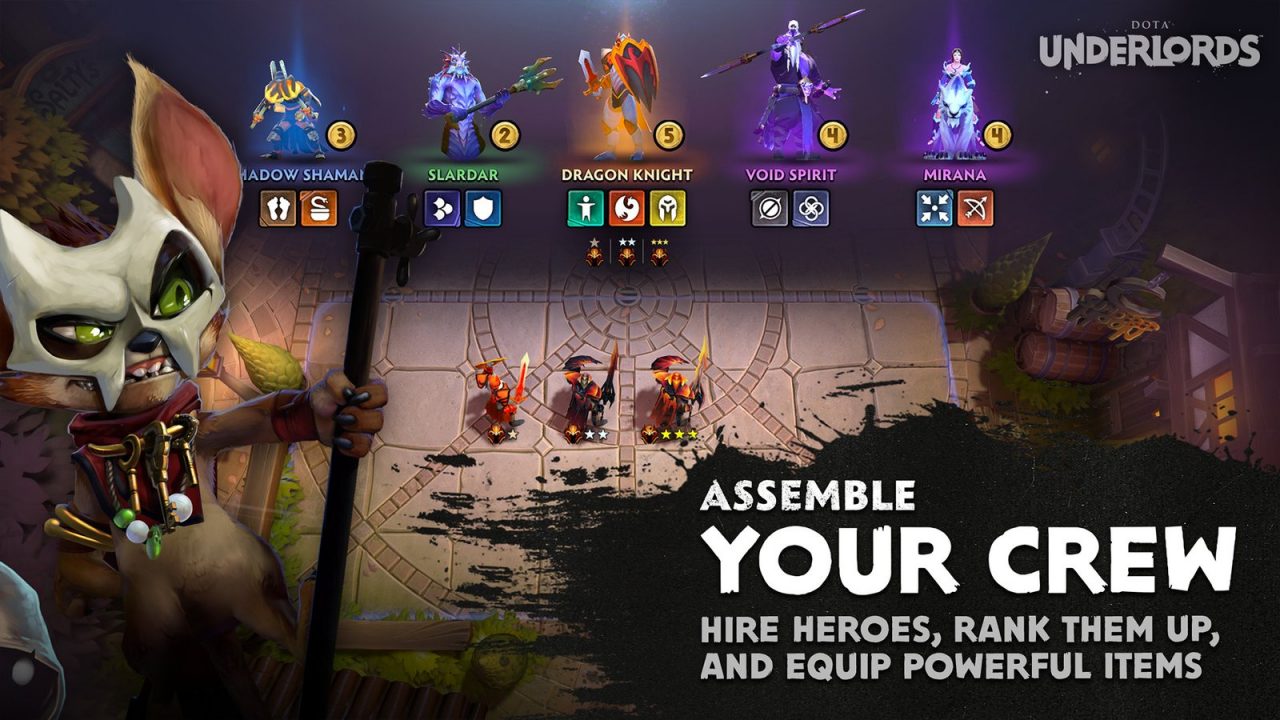
- During the preparation phase of each round, you buy heroes from a small shop, place them on your board and equip items.
- In the combat phase, your heroes fight another player’s heroes automatically. You cannot control them during the fight.
- If you lose, you lose health based on the surviving enemy units. When your health reaches zero, you are eliminated.
- The last player standing wins, and placements determine rank changes.
The early rounds are against computer-controlled creeps, which give players time to build a board, and later PvE rounds against creeps act as loot rounds that hand out items.
Heroes, Tiers and Star Levels
Underlords uses heroes from the Dota universe, around 60 of them at the start of early access. Each hero has a tier that sets how much it costs and how rare it is in the shop. Low-tier heroes are cheap and common; high-tier heroes are expensive and appear more often as your level rises.
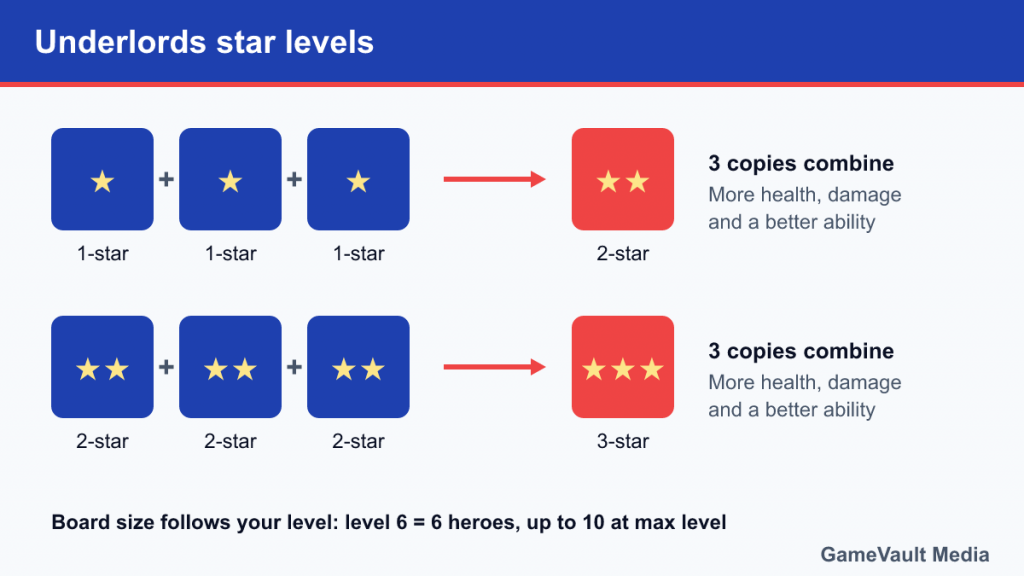
Heroes upgrade through star levels. Three copies of the same hero combine into a 2-star version, and three 2-star versions combine into a 3-star version. Each step adds health and damage and improves the hero’s ability. Because all eight players draw from a shared pool, collecting three copies of a popular hero can be difficult if others are hunting it too.
Your level decides how many heroes you can field, up to ten on the board at the maximum level. Level 6, for example, allows six heroes in play.
Alliances: Underlords’ Synergies
Every hero belongs to two or more alliances, such as Warriors, Mages, Trolls, Humans, Scaled or Dragons. Fielding enough different heroes from the same alliance activates a bonus, and larger numbers unlock stronger tiers of that bonus. Some alliances are defensive, such as extra armor for Warriors; others boost damage or provide unusual effects.
Building a board means balancing alliances. A common approach in Underlords was to pair a primary defensive alliance with a secondary offensive one, so the front line can survive long enough for damage dealers to work. Experienced players also learned that a single strong hero can be worth more than completing an alliance, so chasing every synergy is not always correct.
Season One introduced seasonal rotation: some heroes, items and alliances rotate in and out, so the available options change between seasons rather than remaining fixed.
The Underlords
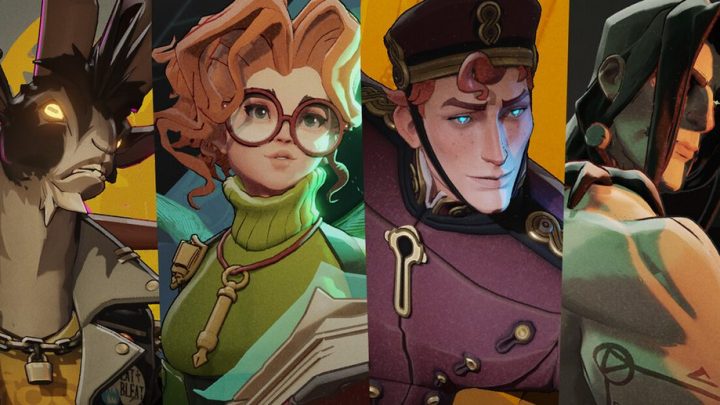
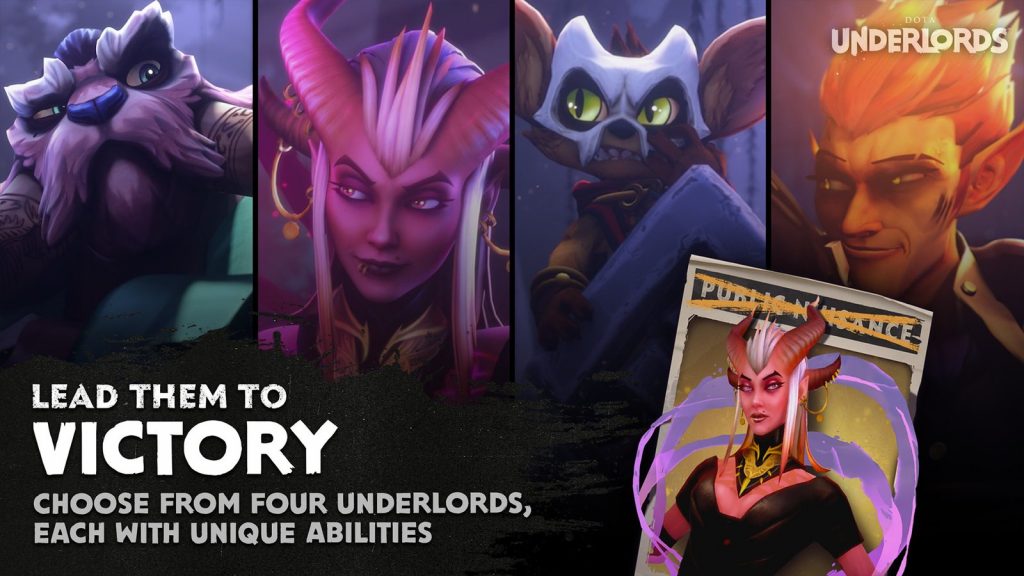
The game’s namesakes are four leaders from the city of White Spire. Rather than fighting as normal units, an Underlord stands on your board as a commander with their own abilities that support your heroes. Under the post-December 2019 rules, you pick one during the match from a choice of Underlords, each offered in two variations that suit different strategies.
| Underlord | General style |
|---|---|
| Hobgen | Aggressive; focused on dealing heavy damage |
| Anessix | Summons demon companions, heals allies and curses enemies |
| Jull | One of the four White Spire leaders, best known for his “Happy Hour” ability, which Valve adjusted several times in patches |
| Enno | The final Underlord, added with the February 2020 launch |
Choosing an Underlord that fits your current board is one of the game’s key strategic decisions. A damage-oriented Underlord helps a board that already wins fights, while a supportive one can stabilize a fragile lineup.
Items
Items come from loot rounds. After certain PvE rounds, you are offered a choice of items and pick one. Underlords grouped items into several categories:
- Offensive items add damage or attack speed.
- Defensive items add health, armor or protective effects.
- Support items provide utility such as mana or healing.
- Global items do not need to be equipped. Once picked, they affect your whole board for the rest of the game, often boosting a specific alliance.
Each hero can hold one non-global item. Unlike Teamfight Tactics, Underlords did not use a component-crafting system; you chose finished items from the offered selection, so matching items to your alliances mattered more than planning recipes.
Gold and Economy
Underlords’ economy is very close to the rest of the genre. During the main part of the game you earn a base income of 5 gold per round, plus 1 gold for winning a round. Win and loss streaks add up to 3 extra gold per round. Interest pays 1 gold for every 10 gold you hold, capped at 5 gold per round once you reach 50 gold.
Two purchases compete with buying heroes:
- Experience: 5 gold buys 4 XP, raising your level and unit cap.
- Rerolls: 2 gold refreshes the shop.
A useful detail for interest is that your gold is snapshotted at the end of the preparation phase, so players often bought heroes after combat began to keep their interest intact. The trade-offs between saving, leveling and rolling work much like those in TFT, which we cover in our TFT economy guide.
Beginner mistakes to avoid
- Buying everything in the shop. Spending down to zero every round throws away interest. Buy what fits your plan.
- Ignoring health. Health is a resource, but once it runs low you must spend to stabilize, not keep saving.
- Forcing one alliance every game. If other players are collecting the same heroes, your upgrades will dry up. Adapt to what the shop offers.
- Forgetting positioning. Durable heroes belong in front, fragile damage dealers behind them.
Game Modes and City Crawl
At full release, Underlords offered several ways to play:
- Standard: the full eight-player strategic match, with ranked matchmaking from the starting rank of Upstart up to Big Boss.
- Knockout: a faster, shorter mode for quick matches.
- Duos: a co-op mode in which two players team up and share health and experience.
- Bot matches: offline play against AI opponents at four difficulty levels.
- Private lobbies: custom matches with friends and spectators.
City Crawl
The headline feature of Season One was City Crawl, a single-player campaign set in White Spire after the death of its crime boss, Mama Eeb. Players moved across a map of the city’s neighborhoods, taking back territory by completing puzzle challenges, street fights and in-game challenges. Completing sections unlocked cosmetic rewards such as outfits, wanted poster art, victory dances and titles. City Crawl was a good way to practice the game’s systems without the pressure of ranked play.
The battle pass
Season One’s battle pass contained more than 100 rewards, many of them free, such as boards, weather effects and profile customization. The paid version was cosmetic only and gave no gameplay advantage.
Underlords in 2026: Can You Still Play It?
Yes, with caveats. As of October 2026, Dota Underlords is still listed as free to play on Steam for Windows, macOS and Linux, and its store page still describes Standard, Knockout and Duos modes, City Crawl and play against bots.
However, the game has not had a new season or major content update for years. Contemporary reports put the last content update in August 2020, and Season One never gave way to a Season Two. Valve has not published a formal end-of-support announcement, but the game is effectively in maintenance. Expect a small ranked community, especially outside peak hours, and treat bot matches and City Crawl as the most reliable ways to play.
If you want an actively updated game with the same core ideas, Teamfight Tactics is the closest equivalent, and our beginner’s guide to TFT explains how it compares.